
Looking to ditch glasses or contacts? LASIK and PRK are two popular surgeries for vision correction. Both reshape the cornea using lasers, but they differ in technique, recovery, and suitability. Here’s what you need to know:
- LASIK creates a corneal flap, offering faster recovery (1–2 days) with minimal discomfort. It’s ideal for those with normal corneal thickness and low-impact lifestyles.
- PRK removes the cornea’s outer layer, making it safer for thin corneas and active individuals. Recovery takes longer (3–6 months for full clarity) and involves more discomfort initially.
Quick Comparison
| Feature | LASIK | PRK |
|---|---|---|
| Technique | Corneal flap creation | Surface layer removal |
| Initial Recovery | 1–2 days | 4–7 days |
| Full Vision Stabilization | A few days to 1 week | 3–6 months |
| Pain/Discomfort | Mild, short-term | Moderate to severe (3–4 days) |
| Best For | Quick recovery, general use | Thin corneas, high-impact activities |
Both surgeries deliver similar long-term results, with around 90% of patients achieving 20/40 vision or better. Choosing the right one depends on your eye health, lifestyle, and recovery preferences. Always consult an eye specialist for personalized advice.
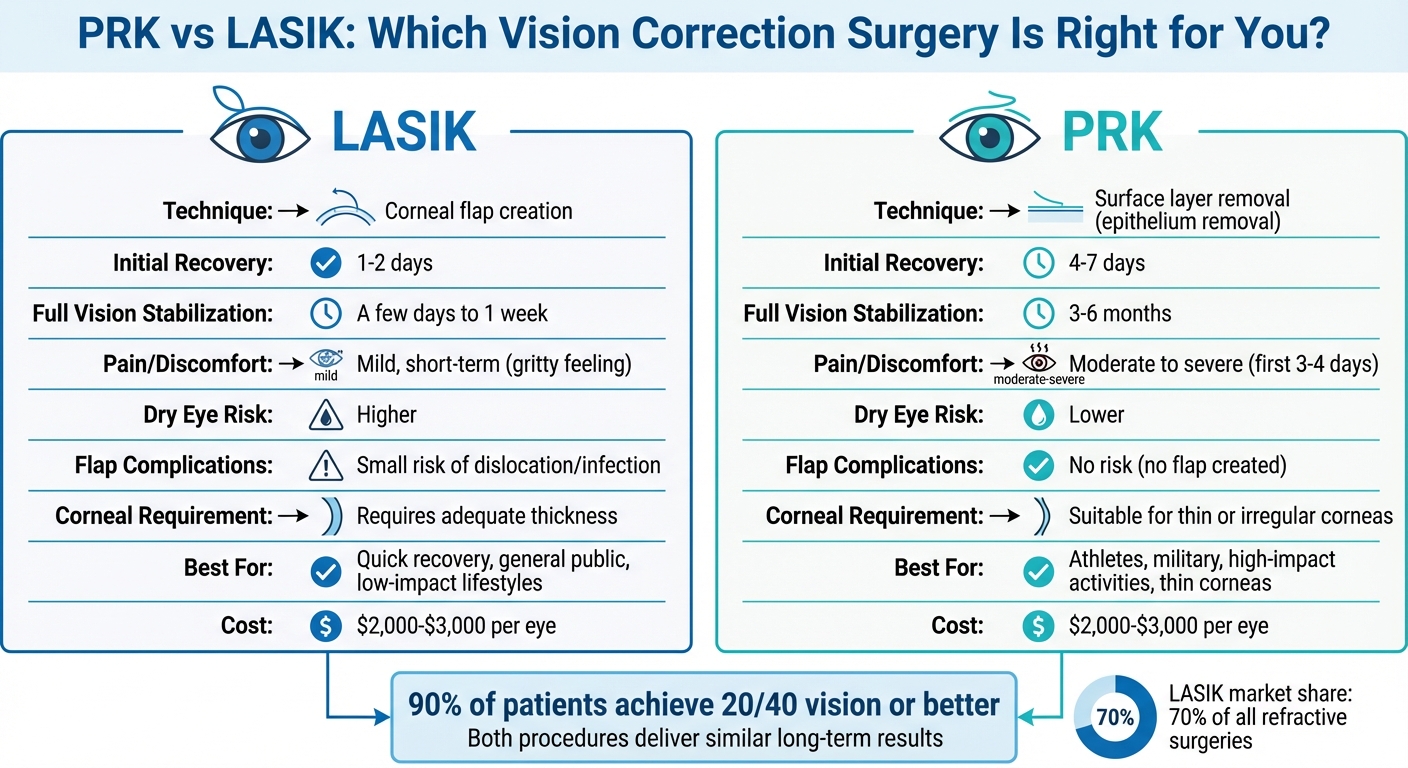
PRK vs LASIK Eye Surgery Comparison Chart
LASIK vs PRK: What’s The Difference Between the Two? (Experience, Procedure, and Recovery)
sbb-itb-929a4e2
What Is LASIK?
LASIK, or Laser-Assisted In Situ Keratomileusis, is a procedure designed to correct common vision issues like nearsightedness, farsightedness, and astigmatism. By reshaping the cornea, LASIK ensures that light entering the eye focuses accurately on the retina, reducing or even eliminating the need for glasses or contact lenses.
Here’s how it works: The process starts with numbing eye drops to keep you comfortable. The surgeon then creates a thin, hinged flap on the cornea’s outer layer using either a femtosecond laser or a microkeratome blade. Once the flap is folded back, an excimer laser reshapes the underlying corneal tissue with precision. Afterward, the flap is carefully repositioned, where it naturally adheres without requiring stitches. Healing begins almost immediately, and most patients notice improvements within hours.
The entire procedure is quick, typically taking only 15 to 20 minutes for both eyes. Results are impressive – about 96% of patients reach their desired vision, and 90% achieve clarity ranging from 20/20 to 20/40.
However, not everyone is an ideal candidate. Having sufficient corneal thickness is essential for LASIK. If the cornea is too thin, PRK (Photorefractive Keratectomy) is often a safer alternative. Understanding these details provides a foundation for comparing LASIK to PRK.
"With LASIK, all that needs to heal is the edge around the flap. So, it doesn’t take long at all for any discomfort to fade and your vision to be clear." – Jason Marcellus, OD, Optometrist
What Is PRK?
PRK, short for Photorefractive Keratectomy, is a laser vision correction procedure that differs from LASIK in a key way: it doesn’t require creating a corneal flap. This difference is what makes PRK a distinct option for vision correction.
Here’s how it works: the procedure begins with numbing eye drops to ensure the patient’s comfort. The surgeon then removes the thin epithelial layer of the cornea using a laser, brush, or chemical solution. Afterward, an excimer laser is used to reshape the corneal tissue with precision. The laser portion of the procedure is quick, typically lasting just 7 seconds, and the entire process for both eyes is completed in about 5 to 15 minutes. Once finished, a clear bandage contact lens is placed over the treated eye to protect it while the epithelial layer naturally regenerates over the next 3 to 7 days.
PRK offers certain advantages, particularly for patients with thin corneas who may not be suitable candidates for LASIK. By avoiding the creation of a flap, PRK preserves more of the corneal structure, making it a viable option for individuals with limited tissue depth. It’s also a preferred choice for people with active lifestyles – like athletes or military personnel – where the risk of flap dislodgement from facial trauma could be a concern.
"PRK involves the mechanical or chemical removal of the corneal epithelium, followed by laser ablation of the underlying stromal tissue. This approach eliminates flap-related complications and preserves more of the corneal tissue."
– Bharat Gurnani, MD, Gomabai Netralaya and Research Centre
The results are impressive: around 90% of patients achieve 20/40 vision or better without needing glasses or contacts after undergoing PRK. Notably, PRK holds the distinction of being the first FDA-approved laser-based refractive surgery, receiving approval in 1996 – three years before LASIK entered the scene.
How PRK and LASIK Differ
When comparing PRK and LASIK, the main difference lies in how surgeons access the corneal tissue that needs reshaping. In LASIK, the surgeon creates a hinged flap on the cornea, folds it back to expose the stromal tissue, reshapes it with an excimer laser, and then repositions the flap. This flap acts as a natural bandage, promoting quick healing.
PRK, on the other hand, involves removing the corneal epithelium entirely using a brush, instrument, or solution. Once the epithelium is removed, the same excimer laser is used to reshape the cornea. A clear bandage contact lens is then placed over the eye to protect it while the epithelium regenerates, which typically takes 3–7 days.
Recovery times differ significantly between the two procedures. LASIK patients generally experience clear vision within 24 hours and mild discomfort, often described as a gritty sensation, lasting only a few hours. PRK patients, however, face a longer recovery period. Vision remains blurry for 3 to 5 days, and moderate irritation is common as the epithelium regrows. Full visual clarity may take several weeks or even months to stabilize.
"With LASIK, all that needs to heal is the edge around the flap. So, it doesn’t take long at all for any discomfort to fade and your vision to be clear." – Jason Marcellus, OD, Cleveland Clinic
PRK does have a key advantage: it eliminates the risk of flap-related complications. Since no flap is created, there’s no chance of dislocation due to trauma or epithelial ingrowth under the flap. This makes PRK an ideal choice for individuals with thin corneas, where creating a LASIK flap might be unsafe, and for those in high-impact professions or sports where facial injuries are more likely.
Despite these procedural differences, both surgeries rely on the same excimer laser technology and produce similar long-term results. Around 90% of patients achieve 20/40 vision or better after either procedure.
Understanding these distinctions highlights the unique advantages and challenges of each surgery, setting the stage for a closer look at their respective pros and cons.
PRK vs. LASIK: Benefits and Drawbacks
Both PRK and LASIK deliver great long-term outcomes, with about 90% of patients achieving 20/40 vision or better. Choosing between them depends on factors like your corneal structure, daily activities, and how much recovery time you can manage.
LASIK stands out for its quick recovery. Most people experience clear vision within 24 hours, with only mild, gritty discomfort lasting 48–72 hours. However, LASIK comes with a slightly higher chance of long-term dry eye because the procedure involves creating a corneal flap, which can affect corneal nerves. There’s also a rare, lifelong risk of flap dislocation due to trauma.
PRK avoids flap-related risks entirely, making it a better option for those with thin corneas or a higher likelihood of dry eye. It’s also a great choice for individuals in high-impact professions – like the military, first responders, or contact sports – where facial injuries are more likely. The downside? Recovery is a bit tougher. Expect moderate to severe discomfort during the first 3–4 days, blurry vision for 1–2 weeks, and a stabilization period that can take 3–6 months.
From a cost perspective, both procedures are fairly similar, typically ranging between $2,000 and $3,000 per eye, depending on the technology used and the surgeon’s expertise. LASIK remains the more popular choice, accounting for roughly 70% of all refractive surgeries each year, largely due to its faster recovery time.
Side-by-Side Comparison
Here’s a quick breakdown of the main differences:
| Feature | LASIK | PRK |
|---|---|---|
| Primary Technique | Corneal flap creation | Surface ablation (epithelium removal) |
| Initial Recovery | 1–2 days | 4–7 days |
| Full Stabilization | A few days to 1 week | 3–6 months |
| Pain/Discomfort | Mild; "gritty" feeling | Moderate to severe (first 3–4 days) |
| Corneal Requirement | Requires adequate thickness | Suitable for thin or irregular corneas |
| Flap Complications | Small risk of dislocation/infection | No risk (no flap created) |
| Dry Eye Risk | Higher | Lower |
| Best For | Quick recovery; general public | Athletes; military; thin corneas |
Recovery Time and Results
LASIK provides quick visual improvement. Most patients notice better vision within 24 hours and are back to their normal routines the next day. The corneal flap typically heals in 1–2 days with only minor discomfort. Vision tends to stabilize within a few days to a week. On the other hand, PRK involves a longer healing process due to the need for epithelial regeneration.
PRK recovery takes more time and patience. During the first 3–4 days, PRK patients often experience blurred vision and discomfort as the epithelium regenerates. A "bandage" contact lens is used during this period to protect the eye. Functional vision usually returns within 1–2 weeks, but full stabilization can take anywhere from 3 to 6 months. This slower recovery process stands in contrast to the quicker timeline associated with LASIK.
"In the first few days after PRK, you may have a lot of irritation because you have an open wound, so to speak, on your cornea. And after that initial healing process, it can still be a few weeks for some people before their vision clears up fully."
- Jason Marcellus, OD, Cleveland Clinic
In the long run, both procedures deliver similar results. Around 90% of patients achieve 20/40 vision or better, and the majority reach 20/25 vision or better, regardless of whether they opt for LASIK or PRK. Once the healing process is complete, both procedures provide excellent and lasting vision correction.
Who Should Choose Each Procedure?
When deciding between LASIK and PRK, understanding your specific needs and circumstances is key. LASIK is often the go-to choice for individuals with sufficient corneal thickness who want a quick recovery. If you’re eager to get back to work or resume driving almost immediately, LASIK might be the better fit. It’s particularly well-suited for people who don’t participate in high-impact sports and prefer minimal discomfort after surgery.
On the other hand, PRK is frequently recommended for those with thinner or irregular corneas, as well as for athletes or individuals involved in high-impact activities. Because PRK doesn’t involve creating a corneal flap, it eliminates the risk of flap-related complications, making it ideal for military personnel, law enforcement officers, and first responders. Additionally, PRK is a viable option for patients who may not qualify for LASIK due to insufficient corneal thickness, as it conserves more corneal tissue.
"Anyone who has a high chance of being hit in the face may not be a good candidate for LASIK."
- Jason Marcellus, OD, Cleveland Clinic
PRK is also a better choice for those dealing with preexisting dry eye symptoms.
To determine the right procedure, a comprehensive eye exam is crucial. This includes evaluating corneal thickness, mapping the surface of the eye, assessing tear film quality, and discussing your lifestyle. For example, you might need to stop wearing contact lenses at least a week before your consultation to ensure accurate measurements. Ultimately, the best procedure will depend on your eye anatomy and how it aligns with your daily activities.
Schedule a Consultation with Denver Eye Surgeons
Now that the differences between PRK and LASIK are clear, the next step is an in-person evaluation to see which procedure suits you best. Your journey toward better vision starts with a thorough eye exam. Denver Eye Surgeons offers free consultations to determine the ideal treatment for your eyes. During the visit, they’ll check your corneal thickness, map your eye surface, and evaluate your overall eye health to recommend the best option.
Denver Eye Surgeons uses the advanced Wavelight EX500 and FS200 Laser Suite, ensuring precision without blades. As the official LASIK partner of the Denver Broncos, they pair state-of-the-art technology with a personalized, patient-first approach.
"Dr. Kumar is very knowledgeable and understanding, easy to talk to and willing to spend as much time as needed answering questions. The procedure itself was a lot easier and quicker than anticipated."
- Kathy Humm
Make sure to stop wearing contact lenses at least one week before your appointment. Payment options include financing for PRK and the ability to use FSA or HSA funds.
To book your free consultation, call 303.273.8761. The team is ready to help you make the best decision for your vision.
Conclusion
Both PRK and LASIK aim to reshape the cornea and address common vision problems. LASIK involves creating a corneal flap, which allows for quicker recovery, while PRK removes the outer layer of the cornea, leading to a longer healing process. Despite these differences, the long-term results are comparable, with around 90% of patients achieving 20/20 vision within a year.
Choosing the right procedure depends on factors like your eye anatomy and daily activities. PRK is often recommended for individuals with thinner corneas or those participating in high-impact sports, while LASIK is a better fit for those seeking a faster recovery and minimal downtime.
Ultimately, the decision should be made after a thorough eye exam. At Denver Eye Surgeons, free consultations include corneal thickness mapping, eye surface assessments, and health evaluations to guide you toward the best option for your vision needs. With cutting-edge technology and personalized care, they ensure your choice aligns with both your lifestyle and eye health.
FAQs
Am I a better candidate for PRK or LASIK?
Whether PRK or LASIK is the better choice depends on several factors, including your eye health, corneal thickness, lifestyle, and personal preferences. PRK might be a better fit for individuals with thinner corneas or those who engage in activities that carry a higher risk of eye injury. On the other hand, LASIK is known for its quicker recovery time. The best way to decide is through a comprehensive eye exam and consultation with a skilled ophthalmologist, like the specialists at Denver Eye Surgeons, who can guide you toward the right option based on your unique needs.
How soon can I drive and go back to work after each procedure?
Recovery times for driving and returning to work vary between LASIK and PRK procedures. If you’ve had LASIK, you might be back behind the wheel within 24–48 hours and ready to return to work in just 1–2 days. On the other hand, PRK recovery takes a bit longer. Most people can resume driving and work within 4–7 days, though some may feel ready in as little as 3 days if their vision stabilizes quickly. Your eye doctor will guide you on when it’s safe, based on your individual healing progress.
Will PRK or LASIK make dry eye worse?
Both PRK and LASIK can aggravate dry eye symptoms, though the degree of risk differs between the two. With LASIK, a corneal flap is created, which can interfere with the nerves responsible for tear production. This disruption may increase the chances of developing or worsening dry eye. On the other hand, PRK skips the flap creation, potentially lowering the risk slightly. However, dry eye can still develop after PRK. Ultimately, the outcome depends on individual factors and the specific procedure performed.