
Routine eye exams are the best way to protect your vision from silent, progressive eye diseases like glaucoma, macular degeneration, and diabetic retinopathy. These conditions often develop without symptoms, making early detection essential. By identifying issues early, doctors can slow or stop vision loss with treatments like prescription drops, laser procedures, or surgery.
Key Points:
- Glaucoma: Damages the optic nerve, causing peripheral vision loss. Half of those affected don’t realize they have it.
- Macular Degeneration: Affects central vision, making reading and recognizing faces difficult. Early signs include protein deposits (drusen) in the retina.
- Diabetic Retinopathy: Harms retinal blood vessels and is a leading cause of blindness in adults. With early detection, 90% of cases can avoid blindness.
Eye exams include tests like pupil dilation, tonometry (eye pressure), and retinal imaging to detect problems before symptoms arise. Adults should start screenings at age 40, with annual exams recommended after age 65. For those with diabetes or a family history of eye disease, more frequent monitoring is crucial.
Takeaway: Regular eye exams can prevent irreversible damage. Don’t wait for symptoms – schedule a check-up to safeguard your vision.
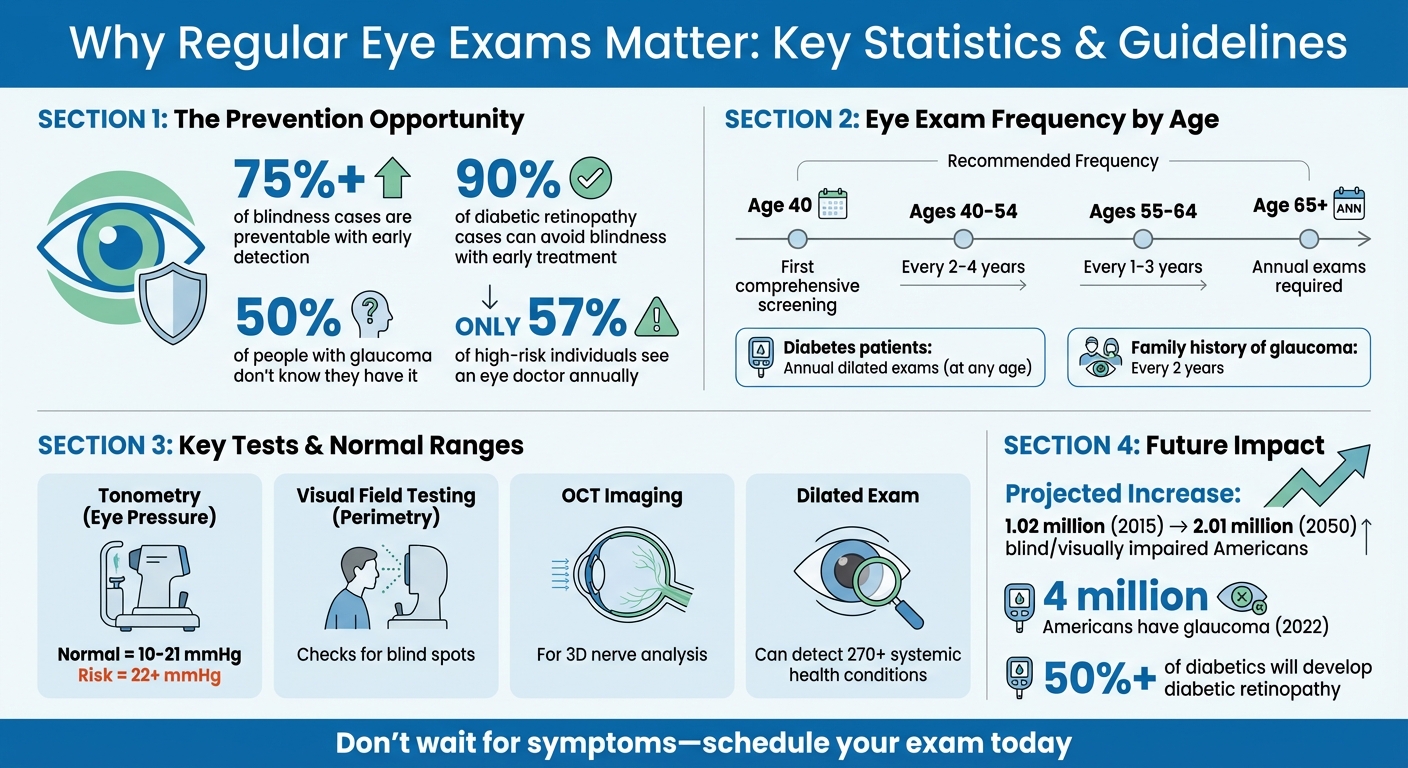
Eye Exam Statistics: Prevention, Detection, and Recommended Frequency by Age
Why Eye Exams Are Important | 5 Reasons To Get Your Eyes Checked
How Eye Exams Detect Eye Diseases Early
A thorough eye exam uses specialized tests to catch eye diseases in their early stages. These tests are designed to identify conditions such as glaucoma, macular degeneration, and diabetic retinopathy before they cause significant damage.
Screening for Glaucoma
Glaucoma detection relies on a combination of tests. Tonometry measures intraocular pressure, with normal levels ranging between 10–21 mmHg. Readings above 22 mmHg could indicate a risk of glaucoma. During ophthalmoscopy, the doctor examines the optic nerve through a dilated pupil, looking for signs of damage like cupping – an enlarged depression in the optic nerve’s center.
Optical Coherence Tomography (OCT) provides detailed 3D images of the optic nerve, allowing doctors to spot microscopic thinning of nerve fibers before vision loss occurs. Perimetry, or visual field testing, maps your entire field of vision, helping to detect blind spots that might otherwise go unnoticed. Additional tests, such as pachymetry (measuring corneal thickness) and gonioscopy (examining the drainage angle), offer critical insights for diagnosing and managing glaucoma effectively.
Identifying Macular Degeneration
The first sign of macular degeneration is often drusen – tiny yellow protein deposits beneath the macula. These can be detected during a dilated eye exam, sometimes years before any vision changes are noticeable. Early detection of drusen allows for timely intervention. Approximately 90% of people with macular degeneration have the slower-progressing "dry" form, making early diagnosis especially important.
OCT scans capture cross-sectional images of the retina, revealing subtle signs like macular thinning or fluid buildup. For patients at higher risk, fluorescein angiography – a procedure where a yellow dye is injected into the arm to map retinal blood flow – can identify leaking blood vessels associated with the more aggressive "wet" form of the disease. Newer imaging techniques, such as OCT angiography, provide similar insights without requiring dye injections.
Monitoring Diabetic Retinopathy
For individuals with diabetes, a comprehensive dilated eye exam is the primary method for detecting diabetic retinopathy. During the exam, the doctor looks for signs like microaneurysms, fluid leakage, or abnormal blood vessel growth in the retina.
"The early stages of diabetic retinopathy usually don’t have any symptoms." – National Eye Institute
When severe retinopathy or diabetic macular edema is suspected, a fluorescein angiogram can produce detailed images of the blood vessels in the retina. In the early stages, doctors may monitor the condition every 2 to 4 months to track its progression. Early and regular monitoring is crucial, as it allows for timely treatment to prevent blindness. Over time, more than 50% of people with diabetes will develop some form of diabetic retinopathy. Fortunately, 90% of diabetes-related blindness is preventable with early detection and treatment.
What Happens During a Complete Eye Exam
A complete eye exam involves a series of tests designed to evaluate your vision and detect early signs of eye conditions. Understanding these steps can help you feel more prepared for your appointment. Each test contributes to building a full picture of your eye health.
Visual Acuity and Refraction Tests
The process usually starts with a visual acuity test using a Snellen chart, which measures how clearly you can see and identifies any refractive errors. This initial check lays the groundwork for more detailed assessments.
Next, your eye doctor will perform a refraction test to pinpoint your precise prescription for glasses or contact lenses. During this test, you’ll look through various lenses and indicate which ones make your vision the sharpest. If you wear glasses or contacts, bring them along so your doctor can review your current prescription.
Pupil Dilation and Retinal Imaging
After testing your vision and prescription, the doctor may dilate your pupils to get a closer look at the internal structures of your eyes. Medicated eye drops are used to temporarily widen your pupils, allowing for a thorough examination of the retina, macula, blood vessels, and optic nerve. This step is crucial for identifying issues like glaucoma, diabetic eye disease, or age-related macular degeneration.
"A dilated eye exam is the only way to detect some common eye diseases in their early stages. These include conditions like glaucoma, diabetic eye disease, and age-related macular degeneration." – CDC
Following dilation, you might experience light sensitivity and trouble focusing on close objects for a few hours. It’s a good idea to bring sunglasses and arrange for someone to drive you home. Interestingly, a 2016 study revealed that 58% of asymptomatic patients undergoing routine eye exams showed changes that required medical attention.
Measuring Eye Pressure
Another key part of the exam is measuring eye pressure, which helps screen for glaucoma. Tonometry, the test used for this, often involves a quick puff of air to flatten your cornea and measure the pressure inside your eye. Healthy eye pressure typically falls between 10 and 21 mmHg, with higher readings signaling an increased risk of glaucoma.
"It is critical to get your eyes examined, even if you feel fine, because there are eye conditions that may be totally asymptomatic, and for glaucoma, early diagnosis and treatment can prevent permanent vision loss later." – Dr. Vicente Diaz, Yale Medicine Ophthalmologist
In 2022, approximately 4 million people in the United States were living with glaucoma, though nearly half were unaware they had it. Your doctor may also use a slit lamp to closely examine the front parts of your eye, such as the eyelids, cornea, iris, and lens, to check for issues like cataracts or corneal ulcers.
sbb-itb-929a4e2
The Benefits of Early Detection and Treatment
Preventing Vision Loss
Catching eye problems early can save your vision. More than 75% of blindness cases are preventable if issues are identified and treated in time. The key is acting before symptoms appear, as treatments are most effective during the early stages of eye diseases.
For individuals with diabetes, early intervention not only helps avoid blindness but also allows for simpler and more effective treatment options. In the case of glaucoma, while existing damage cannot be undone, starting treatment early can significantly slow or halt its progression. Options such as prescription eye drops, laser treatments, or minimally invasive surgeries can be instrumental in managing the condition.
"If you are developing glaucoma, we want to catch it as soon as possible and start treatment as early as possible to prevent extensive, permanent vision loss." – Dr. Vicente Diaz, Yale Medicine Ophthalmologist
Early treatments are often less invasive and more manageable. For example, prescription eye drops can either reduce fluid production or improve drainage in the eyes. Laser trabeculoplasty enhances fluid flow, and minimally invasive glaucoma surgery (MIGS) – often performed alongside cataract surgery – provides another effective option. These treatments are far less complex compared to the advanced surgical procedures required when diseases progress unchecked.
This underscores the importance of early detection, which ensures access to effective and straightforward treatments.
Why Choose Denver Eye Surgeons
Denver Eye Surgeons builds on the advantages of early detection by offering expert care tailored to protect your vision. Their services include advanced eye exams, specialized glaucoma treatments like the iStent procedure, and comprehensive retina care. With same-day appointments and a patient-first approach, they provide everything from routine monitoring to advanced medical treatments for retinal diseases. Their focus remains on preserving your vision through timely and effective intervention.
How Often Should You Get an Eye Exam?
Getting regular eye exams is crucial – not just for spotting silent eye diseases but also for tailoring the frequency of those exams based on your personal risk factors.
Guidelines for Adults and Seniors
How often you should get an eye exam depends a lot on your age. According to the American Academy of Ophthalmology, the first comprehensive eye screening should happen at age 40, as this is when early signs of eye diseases and vision changes often start to show up. For adults between 40 and 54 years old, exams are recommended every 2–4 years. From ages 55 to 64, that interval shortens to every 1–3 years.
Once you hit age 65, annual eye exams become a must. Conditions like cataracts and macular degeneration are more common as you age, and regular check-ups help keep these in check. Meanwhile, the American Optometric Association suggests annual exams for all adults aged 18 to 64. Why? Routine eye exams can detect over 270 systemic health issues – like high blood pressure, diabetes, and even some cancers – often before you notice any physical symptoms.
"A lot of times, we can see things in the eye before they manifest into visual symptoms. It’s always best to catch that at an early stage." – Dr. Aleksandra Rachitskaya, Ophthalmologist and Retina Specialist, Cleveland Clinic
If you have specific health conditions, like diabetes, you’ll need to follow a stricter exam schedule.
Eye Care for Diabetics
For those with diabetes, yearly comprehensive dilated eye exams are non-negotiable. Diabetic retinopathy is the leading cause of blindness among working-age adults, and while it increases the risk of vision loss by 25 times, over 90% of cases can be managed or prevented with early detection and treatment.
Medicare Part B helps cover 80% of the cost for annual eye exams for people with diabetes, making it easier to stay on top of your eye health. Watch for warning signs like dark floaters, double vision, or sudden blurry vision, and report these to your doctor right away.
When Family History Increases Risk
Your family history can also play a big role in your eye health. If you have relatives with conditions like glaucoma or macular degeneration, you’re at a higher risk and may need more frequent exams. For example, if glaucoma runs in your family, a dilated eye exam every 2 years is recommended. Make sure to discuss your family’s eye health history with your doctor.
Despite these recommendations, only about 57% of people at high risk for vision loss visit an eye doctor each year. With the number of blind or visually impaired individuals in the U.S. expected to double from 1.02 million in 2015 to 2.01 million by 2050, staying proactive with regular eye exams has never been more crucial.
Conclusion
Vision loss caused by glaucoma or macular degeneration cannot be reversed. However, early detection and timely treatment can prevent blindness in 90% of diabetic retinopathy cases and help preserve vision in conditions like glaucoma.
Shockingly, about half of those with glaucoma don’t even know they have it, and only 57% of individuals at high risk make it a point to see an eye doctor annually. The key takeaway? Don’t wait for vision changes to act – damage to the retina or optic nerve is permanent. Dr. Chantal Cousineau-Krieger from the National Eye Institute emphasizes this urgency:
"You can have damage to your retina or optic nerve and not notice until it has cost you your vision".
Regular eye exams are more than just a health check – they’re a way to maintain your independence and quality of life. Whether it’s reading, driving, or recognizing the faces of loved ones, healthy vision is essential. With this knowledge, taking proactive steps to protect your sight becomes non-negotiable.
If you’re in the Denver area and overdue for a comprehensive eye exam, now is the time to act. Denver Eye Surgeons provides cutting-edge diagnostic tools, board-certified specialists, and even same-day appointments to help you safeguard your vision. Visit denvereyesurgeons.com today and take the first step toward protecting your eyesight for the future.
FAQs
Do I need more frequent eye exams if eye diseases run in my family?
If eye conditions like glaucoma, macular degeneration, diabetic retinopathy, or severe cataracts run in your family, you might need more frequent eye exams. Having close relatives – such as parents, siblings, or grandparents – with these conditions can increase your chances of developing them. Regular eye check-ups are key to spotting early warning signs and helping to prevent vision loss.
Consider these questions:
- Does a parent, sibling, or other close relative have a serious eye condition?
- Has anyone in your family been diagnosed with an eye disease at an unusually young age?
- Do you share additional risk factors like diabetes or high blood pressure?
If you answered "yes" to any of these, it’s often recommended to schedule a comprehensive eye exam every year. At Denver Eye Surgeons, our skilled team can evaluate your family history, determine your risk, and develop a customized exam plan to help safeguard your vision.
What are the early warning signs of glaucoma or macular degeneration?
Glaucoma tends to creep in silently during its early stages, often without any obvious warning signs. However, some people might notice a loss of peripheral vision, blurred vision, or heightened sensitivity to glare at night. If it goes untreated, the condition can worsen, potentially leading to significant vision loss, including problems with central vision.
Macular degeneration, on the other hand, might show up as distorted or blurry central vision, trouble reading small text, or straight lines appearing wavy. The key to managing both conditions is regular eye exams. These check-ups can catch issues early – sometimes even before symptoms become noticeable – offering a better chance to protect your vision in the long run.
How can routine eye exams detect problems before symptoms appear?
Regular eye exams play a crucial role in spotting potential eye problems early – often before you even notice any symptoms. During these check-ups, your eye doctor might conduct tests such as measuring intraocular pressure, retinal imaging, and visual field assessments. These evaluations can detect early warning signs of conditions like glaucoma, macular degeneration, cataracts, and other eye-related diseases.
Catching these issues early allows for timely treatment, which can safeguard your vision and help avoid more severe complications. Making routine eye care a priority is an easy yet impactful way to maintain your long-term eye health.