
LASIK usually offers faster recovery. PRK avoids a corneal flap. My main takeaway: ask your surgeon which option fits your corneal shape, thickness, and dry-eye status – not just your schedule.
LASIK often restores functional vision within 1–2 days. PRK usually means more early discomfort, with functional vision improving over days to weeks. Both can cause lasting dry eye, glare, halos, or a remaining prescription. Neither guarantees 20/20 vision or prevents the need for reading glasses.
Quick Comparison
| Factor | LASIK | PRK |
|---|---|---|
| Procedure | Reshapes tissue beneath a corneal flap | Removes the surface layer; no flap |
| Recovery | Usually faster, with less early discomfort | Slower, with more early discomfort |
| Main procedure-specific risk | Flap problems, including after an eye impact | Corneal haze during healing |
| Thin corneas | Needs enough tissue for the flap and correction | May suit some patients, but not all |
| Contact sports | Eye impacts can damage the flap | Avoids flap-related injuries |
| Further correction | Depends on stable vision and safe tissue limits | Often requires a longer healing period |
I’d bring my prescription history, medication list, and questions about work, night driving, and sports to the exam. <u>A thin cornea does not automatically make PRK safe</u>, and active dry eye needs care before either procedure.
Whichever option you choose, follow-up visits and prescribed drops matter. Severe pain, sudden vision loss, increasing redness, or discharge need prompt eye care.
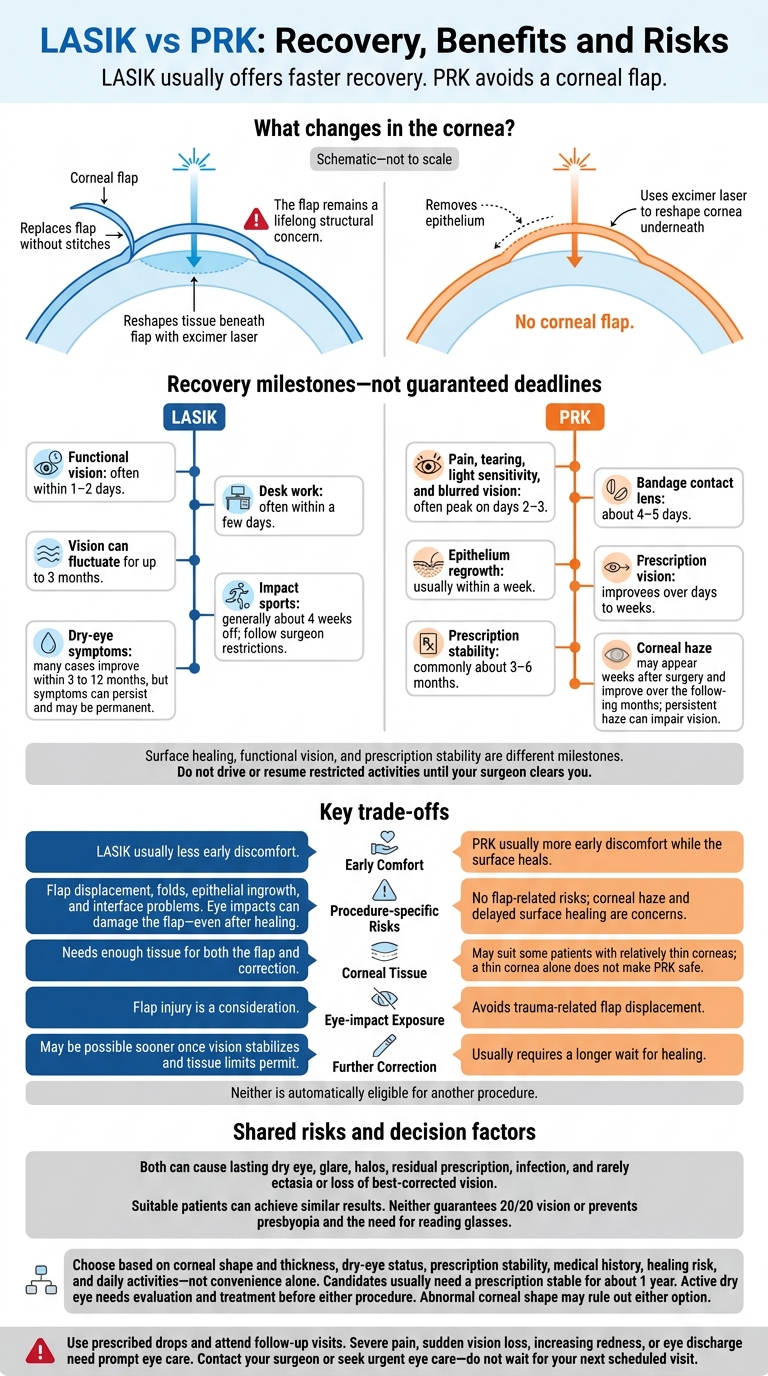
LASIK vs PRK: Recovery, Benefits and Risks
LASIK vs PRK – What’s the Difference?
sbb-itb-929a4e2
LASIK: Benefits, Risks, and Recovery
LASIK creates a thin flap in the cornea, reshapes the tissue beneath it with an excimer laser, and replaces the flap without stitches. The procedure permanently changes the cornea, so the flap remains a lifelong structural concern. Compared with PRK, LASIK generally offers faster vision recovery and greater comfort. But the flap also brings its own risks.
Early Vision and Comfort After LASIK
Burning, watering, a gritty feeling, and light sensitivity are common early on. Vision can fluctuate for up to 3 months. Arrange a ride home, and don’t drive until your surgeon clears you.
Desk work is often possible within a few days, though screen use can worsen temporary dryness. Use your prescribed drops, avoid rubbing your eyes, and follow your surgeon’s activity restrictions. Impact sports generally require about 4 weeks off.
Dry Eye, Flap Problems, and Other LASIK Risks
Creating the flap cuts corneal nerves, which can contribute to dry eye. Symptoms include burning, fluctuating vision, redness, a feeling that something is in your eye, and light sensitivity. Many cases improve within 3 to 12 months, but symptoms can persist and may be permanent.
Glare, halos, starbursts, reduced contrast, and impaired night vision can make night driving difficult. A remaining prescription may mean you still need glasses or additional treatment. Another procedure isn’t automatically safe or appropriate. Infection, inflammation, and, rarely, loss of best-corrected vision are also possible.
Rubbing your eyes or taking a blunt hit to the eye can displace the flap – even after healing. Another rare but serious risk is corneal ectasia, in which the cornea weakens and bulges, distorting vision. The risk is higher if the cornea is abnormal or too little tissue remains after surgery. Treatment may involve specialty contact lenses, corneal cross-linking, or, in advanced cases, a corneal transplant.
Seek prompt eye care for sudden vision changes, marked pain, increasing redness, discharge, severe light sensitivity, or a new feeling that something is in your eye.
Corneal Health and Prescription Stability
Before approving surgery, your surgeon checks whether your cornea can safely support both the flap and the planned correction. Candidates usually need a prescription that has stayed stable for about 1 year. Screening measures corneal thickness and uses topography or tomography to check for keratoconus and other corneal abnormalities.
Bring your previous prescriptions, and report dry-eye symptoms or medical conditions that could affect healing. Stop wearing contact lenses for the period your practice recommends before measurements. Ask how much tissue the correction will remove and how much will remain beneath the flap. Both help determine whether LASIK is suitable for you.
PRK: Benefits, Risks, and Recovery
When LASIK isn’t a good fit because of flap-related risks or corneal limits, PRK offers another option – with slower surface healing. The surgeon removes the epithelium, then uses an excimer laser to reshape the cornea underneath. A bandage contact lens protects the eye for about 4–5 days as the epithelium grows back, usually within a week.
Flap-Free Surgery and Thinner Corneas
PRK avoids corneal-flap complications, which matters for people more likely to experience an eye impact. It may also work for some patients with relatively thin corneas. But a thin or abnormal cornea doesn’t automatically make someone a candidate: keratoconus or other structural problems can still rule out PRK.
Discomfort, Corneal Haze, and Other PRK Risks
Pain, tearing, light sensitivity, and blurred vision are common, often peaking on days 2–3. PRK can also cause corneal haze – a usually temporary clouding caused by healing that’s more likely after higher corrections. Haze may appear weeks after surgery and improve over the following months, though persistent haze can impair vision.
Other risks include infection, delayed healing, worsening dry eye, residual prescription, glare, and halos. Rare risks include ectasia or loss of best-corrected vision. You may still need glasses or further treatment.
Use antibiotic, anti-inflammatory, and lubricating drops exactly as prescribed. Steroid drops may be needed for weeks or months. In some cases, the surgeon may apply mitomycin C to reduce the risk of haze. Don’t remove the bandage lens yourself, and contact the practice if it falls out. Worsening pain or deteriorating vision needs prompt assessment.
Surface Healing and Vision Recovery
PRK avoids flap risks, but recovery is slower and more uncomfortable than with LASIK. Functional vision may take days to weeks to improve. Prescription stability commonly takes about 3–6 months, long after the surface has healed.
Arrange rides for surgery and early follow-up visits, and leave room for extra time away from visually demanding work. Don’t count on driving by a fixed recovery date. Resume swimming, strenuous exercise, and contact sports only after your surgeon confirms that your eye has healed enough.
LASIK vs PRK: Side-by-Side Comparison
Compare recovery time, flap risks, and corneal tissue requirements to see how each procedure fits your eyes and daily routine.
| Factor | LASIK | PRK |
|---|---|---|
| Approach | Creates a corneal flap and reshapes the tissue beneath it | Removes the surface layer and reshapes the cornea without a flap |
| Return to routine | Usually sooner, with less early discomfort | Usually later, with more discomfort while the surface heals |
| Dry eye | Can cause lasting dryness | Can also cause lasting dryness |
| Thin corneas | Requires enough tissue for both the flap and correction | May suit some patients; a thin cornea alone does not make PRK safe |
| Contact sports | Eye impacts can injure the flap | Avoids trauma-related flap displacement |
| Flap risks | Displacement, folds, epithelial ingrowth, and interface problems | No flap-related risks |
| Corneal haze | Less characteristic | A recognized healing risk |
| Additional correction timing | May be possible sooner once vision stabilizes after LASIK | Usually requires a longer wait for healing after PRK |
Suitable patients can achieve similar results, but neither procedure guarantees 20/20 vision. Neither prevents presbyopia – the age-related loss of near focusing that often leads to a need for reading glasses.
Recovery time is only part of the decision. Corneal safety, dry-eye risk, and your exposure to eye impacts also matter.
How Eye Health and Lifestyle Guide the Choice
| Your priority or finding | What to discuss |
|---|---|
| Limited time away from work | Whether LASIK’s faster recovery fits your eye measurements and job demands |
| Thin cornea | Whether PRK leaves enough safe tissue; an abnormal corneal shape may rule out either procedure |
| Boxing, martial arts, or occupational eye-impact exposure | Whether avoiding a flap makes PRK a better fit |
| Dryness or fluctuating vision | Treating the ocular surface before choosing either procedure |
Active dry eye needs evaluation and treatment before either surgery. Neither procedure is safer or more effective for everyone. Your eye measurements, healing risks, and daily activities help guide the choice.
The eye exam helps show which trade-offs matter most for you.
What the Preoperative Eye Exam Checks
The exam includes tear-film testing, pupil assessment, and screening for other eye diseases, with dilation when appropriate. The results help determine whether LASIK, PRK, or neither is right for your eyes. Discuss your driving, screen work, and recovery needs during the visit.
Pregnancy-related prescription changes, breastfeeding, active eye disease, abnormal corneal shape, autoimmune disease, certain medications, and conditions that affect healing may mean delaying surgery or ruling it out.
Laser vision correction does not treat diabetic eye disease, retinal disease, glaucoma, or cataracts. These conditions need separate assessment and may limit how much either procedure can improve your vision.
Conclusion: Base Your Choice on Eye Health and Recovery
LASIK offers faster recovery, while PRK avoids a corneal flap. But eye health should guide your choice – not convenience alone. Your corneal shape and thickness, dry-eye status, prescription stability, medical history, and healing risk all matter.
Follow-Up Care and Warning Signs
Use every prescribed drop as directed, avoid rubbing your eyes, and follow instructions for protective eyewear. After PRK, use UV protection, too. Attend every scheduled follow-up visit, and get clearance before returning to driving, work, swimming, contact sports, or eye makeup.
Severe pain, sudden vision loss, increasing redness, or eye discharge need prompt care. Contact your surgeon or seek urgent eye care. Don’t wait for your next scheduled visit.
Discuss Your Options With Denver Eye Surgeons
Denver Eye Surgeons in Denver, Colorado, can assess whether LASIK or PRK fits your eye measurements and recovery needs.
Bring your exam results, prescription history, and medication list to your consultation. Discuss any eye conditions, work demands, and sports or other activities that could expose your eyes to injury. Ask how your findings affect your treatment options and recovery plan.
FAQs
How do I weigh faster recovery against long-term risks?
LASIK and PRK offer similar long-term vision outcomes, but their recovery times and risks differ.
With LASIK, you can typically return to daily activities within 24–48 hours. However, it comes with rare, lifelong flap-related risks and a higher risk of persistent dry eye. PRK avoids flap-related risks, but recovery takes longer and includes discomfort and blurry vision.
An eye specialist at Denver Eye Surgeons can help you weigh your corneal health, work demands, and recovery preferences.
What options do I have if neither surgery is safe?
If LASIK or PRK isn’t right for you, Denver Eye Surgeons offers other options to help you see clearly without corrective eyewear. These include Refractive Lens Exchange (RLE) with monofocal or premium intraocular lenses (IOLs) and the Implantable Collamer Lens (EVO Visian ICL).
Your eye anatomy and medical history help determine which procedures may be right for you. Schedule a complimentary consultation for a thorough evaluation to find the safest, most effective option for your needs.
How will I know if I need another correction?
A follow-up evaluation can help determine whether you need more treatment. Denver Eye Surgeons offers personalized follow-up appointments to check your recovery and discuss any concerns.
Contact your eye surgeon immediately if you experience worsening vision, severe pain, redness that doesn’t go away, d