
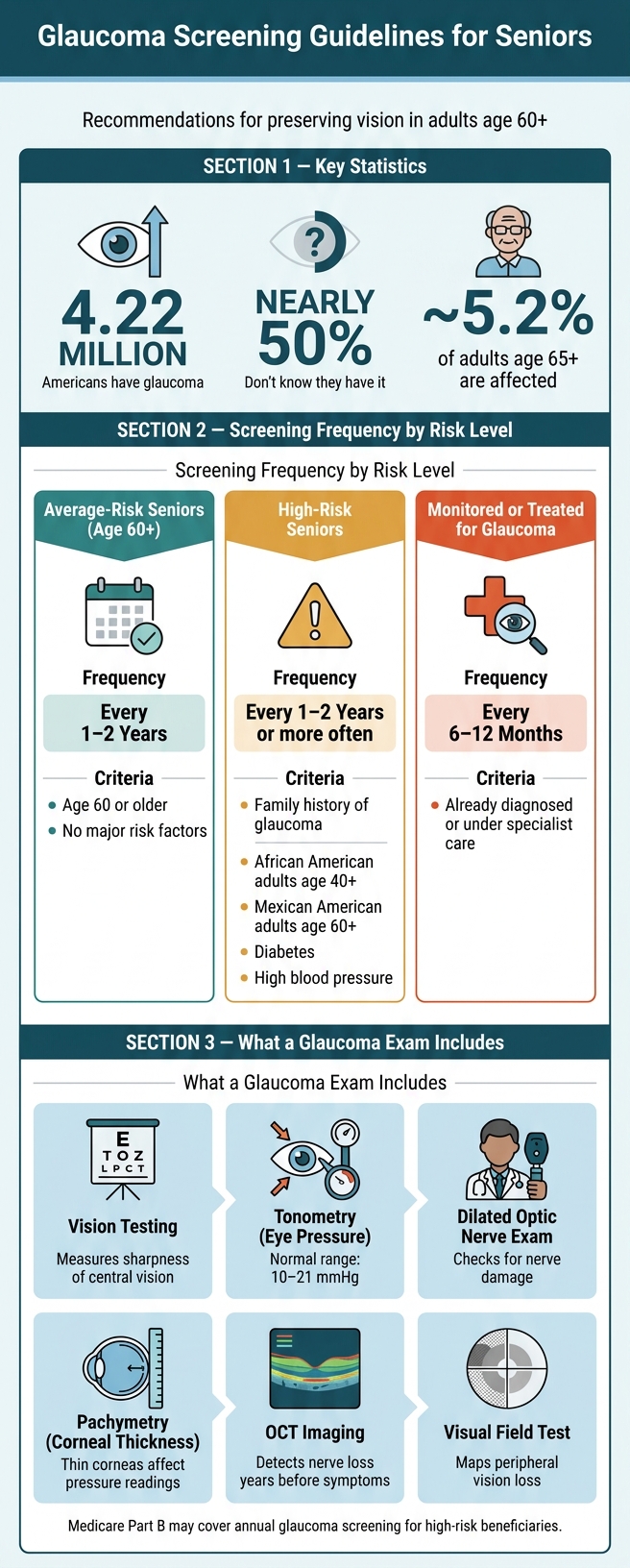
Glaucoma can steal sight without pain or early warning signs. If I’m age 60 or older, I should plan for a dilated eye exam every 1 to 2 years, and if I have higher risk – like family history, diabetes, African American background, or Hispanic background at older ages – I may need checks every 6 to 12 months.
Here’s the short version:
- Glaucoma often starts silently
- Side vision loss can happen first
- A pressure check alone is not enough
- A dilated eye exam helps find nerve damage early
- About 4.22 million Americans have glaucoma, and nearly 50% do not know it
- About 5.2% of adults age 65+ are affected
If I’m on Medicare, Part B may cover one glaucoma screening each year if I’m in a high-risk group.
A glaucoma visit may include:
- Vision testing
- Eye pressure testing
- Dilated optic nerve exam
- Corneal thickness check
- OCT scan
- Visual field test
The main takeaway is simple: most seniors should not wait for symptoms. By the time vision changes are easy to spot, the damage may already be permanent.
What Happens at a Glaucoma Eye Exam? Screening Tests Explained by a Glaucoma Specialist
sbb-itb-929a4e2
Understanding glaucoma in older adults
Glaucoma harms the optic nerve, often when pressure inside the eye gets high enough to damage nerve fibers. That nerve carries visual signals from the eye to the brain, and it can be slowly damaged for quite a while before someone realizes anything is off.
There are two main types to know about. Primary open-angle glaucoma is the most common. It develops slowly, usually without pain and without clear early warning signs. Angle-closure glaucoma is less common, but it can get worse fast.
For older adults, that slow start is a big part of the problem. Damage may begin long before symptoms show up. Risk goes up a lot after age 60. Hispanic and Mexican American adults face higher risk starting around age 65.
Why glaucoma is often missed early
Glaucoma often affects side vision first. Because that loss happens little by little, many people don’t notice it until the disease is far along. At that point, the damage is often severe and irreversible.
A pressure check alone isn’t enough. Tonometry cannot rule out glaucoma. Doctors need a full dilated eye exam to look at the optic nerve closely.
How glaucoma affects daily life for seniors
When side vision starts to shrink, daily life can get harder in quiet, subtle ways. It becomes tougher to notice people nearby, spot obstacles, or see traffic coming from the side. That can increase the risk of falls and make driving more dangerous, especially in low light.
Because these shifts happen gradually, many seniors may not pick up on them right away.
Who needs glaucoma screening and how often
Glaucoma Screening Schedule for Seniors: Risk Levels & Exam Frequency
Glaucoma often has no early warning signs. That’s what makes regular screening so important. In many cases, it’s the only way to spot the disease before vision loss gets worse.
Glaucoma screening is usually part of a comprehensive dilated eye exam. That exam checks your optic nerve, eye pressure, and visual acuity. The National Eye Institute says higher-risk adults are best screened with a comprehensive dilated eye exam.
For many older adults, regular screening makes sense. Your eye doctor will decide how often you should come in based on your age, family history, and other risk factors.
Exam schedules based on risk level
For most seniors age 60 and older, a dilated eye exam every one to two years is a solid starting point. If you’re already being watched or treated for glaucoma, visits are usually more frequent, often every 6 to 12 months.
| Risk Category | Typical Exam Interval |
|---|---|
| Average-risk seniors (age 60+) | Every 1 to 2 years |
| High-risk seniors (family history, African American adults 40 and older, Mexican American adults 60 and older) | Every 1 to 2 years, or more often based on your eye doctor’s judgment |
| People being monitored or treated for glaucoma | Every 6 to 12 months (or as directed by a specialist) |
Medicare coverage for glaucoma screening

Screening advice and insurance coverage aren’t always the same thing. Medicare Part B may cover an annual glaucoma screening for high-risk beneficiaries. That includes people with a family history of glaucoma, diabetes, African American adults 50 and older, and Hispanic Americans 65 and older.
Glaucoma risk factors seniors should know
Your risk factors help shape how often you should get checked for glaucoma. Some run in families. Others show up later in life. Either way, they’re worth bringing up at your next eye appointment.
Eye and medical factors that raise glaucoma risk
Elevated eye pressure – also called intraocular pressure, or IOP – is the main and only risk factor doctors can change when it comes to glaucoma development and progression. Higher IOP increases your risk. That said, glaucoma can still happen even when eye pressure looks normal.
Thin corneas are also linked to a higher chance of glaucoma. Eye doctors measure corneal thickness with pachymetry, which is often part of a full glaucoma workup. Severe nearsightedness is tied to a higher risk of open-angle glaucoma, while farsightedness is linked with acute angle-closure glaucoma.
Past eye injuries or surgeries can matter too. That includes procedures like retinal detachment repair. It’s also smart to tell your eye doctor if you’ve used steroids for a long time, whether as eye drops, inhalers, or pills. Steroids can increase IOP and may lead to steroid-related glaucoma.
Family history, ethnicity, and chronic health conditions
Family history is one of the strongest risk factors. If a parent or sibling has glaucoma, your own risk goes up a lot. Ethnicity also plays a big role. African Americans face up to a 15-fold increased risk of blindness from open-angle glaucoma compared with other groups. African Americans age 40 and older, along with Mexican Americans age 60 and older, are seen as high-risk groups and may need earlier, more frequent screening.
Chronic health issues can add to that risk. Diabetes, high blood pressure, heart disease, and sleep apnea are all linked with higher rates of glaucoma. If you have diabetes, getting a dilated eye exam at least once a year is strongly advised. Even without symptoms, any of these factors may mean you need screening sooner or more often.
These details help your eye doctor decide which tests to run and when to repeat them.
What to expect during a glaucoma screening exam
A glaucoma screening is painless and usually takes 45 to 90 minutes if your eyes are dilated. For seniors, it helps to know what the visit looks like before you walk in. Bring sunglasses, because your eyes may feel more sensitive to light after dilation.
Glaucoma screening isn’t just a pressure check. Doctors use several tests because each one shows a different piece of the picture.
History review, vision check, and eye pressure testing
The exam usually starts with a review of your medical history, family history, and any medications you take, including steroids. Then the doctor checks your vision and eye pressure.
A standard visual acuity test measures how sharp your central vision is. After that, tonometry measures intraocular pressure. Normal IOP usually falls between 10 and 21 mmHg.
That said, a normal pressure reading does not rule out glaucoma. Early glaucoma often has no symptoms, so pressure is only one part of the exam.
Dilated exam, corneal thickness, OCT, and visual field testing
Eye drops are used to dilate your pupils so the doctor can look directly at the optic nerve for changes. Pachymetry measures corneal thickness. This matters because thin corneas can lead to pressure readings that come in lower than they should. OCT imaging scans the nerve fiber layer and can detect nerve loss years before symptoms appear. Visual field testing maps your peripheral vision to spot blind areas, which are often the first sign of glaucoma.
Put simply, these tests check different parts of glaucoma risk and damage.
| Test | What It Measures | Why It Matters for Seniors |
|---|---|---|
| Tonometry | Intraocular pressure | High pressure is a primary risk factor for nerve damage. |
| Dilated exam | Optic nerve | Detects changes in the optic nerve. |
| Pachymetry | Corneal thickness | Thin corneas can lead to underestimated pressure readings. |
| OCT Imaging | Nerve fiber layer thickness | Can detect nerve loss years before symptoms appear. |
| Visual field testing | Peripheral vision | Identifies blind spots, often the first sign of glaucoma. |
Together, these tests create a baseline for follow-up and treatment decisions. The results help your doctor decide how often you need to come back and what the next step should be.
Screening, follow-up, and long-term glaucoma care
After screening, the next step depends on the result. A normal exam usually means routine follow-up. A suspicious result means closer watch. And if glaucoma is confirmed, treatment starts right away.
If your results show things like high eye pressure or an optic nerve that doesn’t look normal, you may be labeled a glaucoma suspect. That usually means follow-up visits every 6 to 12 months.
| Screening Result | Follow-Up Frequency | Next Step |
|---|---|---|
| Glaucoma suspect | Every 6–12 months | Repeat OCT and visual field testing |
| Confirmed glaucoma | As directed by specialist | Medication, laser therapy, or surgery to lower IOP |
Once glaucoma is confirmed, the focus changes. Now the goal is to lower eye pressure and watch for nerve damage over time. Treatment may include eye drops, SLT laser treatment, or surgery. Repeat testing, including OCT scans and visual field analysis, helps show whether the treatment is doing its job.
How seniors can stay on schedule and slow vision loss
Once treatment begins, what you do at home matters just as much as what happens in the exam room. If you’ve been prescribed pressure-lowering drops, use them every day and don’t skip doses, even if your vision seems fine. That’s one of the tricky parts of glaucoma: it often has no early symptoms, so it can feel like nothing is wrong when damage is still happening.
Your general health plays a part too. Keeping blood sugar and blood pressure under control can help support blood flow to the optic nerve. And if you use corticosteroids in any form, including eye drops, inhalers, creams, or pills, talk with your care team. Steroids can significantly raise eye pressure.
Key glaucoma screening guidelines seniors should remember
Glaucoma usually doesn’t announce itself. In many cases, by the time vision loss becomes noticeable, the damage has already been done. That’s why sticking to the screening schedule matters so much.
Most seniors should get a comprehensive eye exam every 1 to 2 years. If you have risk factors like family history, diabetes, elevated pressure, or certain ethnic backgrounds, visits every 6 to 12 months make more sense. About 4.22 million Americans live with glaucoma, and nearly 50% don’t know they have it. That’s a big reason regular appointments are one of the best ways to catch it before it affects your sight. The National Eye Institute recommends a comprehensive dilated eye exam for finding glaucoma in people at higher risk.
FAQs
Can I have glaucoma with normal eye pressure?
Yes. This is called normal-tension or low-tension glaucoma, and it makes up about one-third of glaucoma cases in the United States.
That’s why eye pressure, by itself, doe