
Eye exercises can help reduce strain and improve focus temporarily, but they won’t reverse age-related vision changes like presbyopia or serious conditions like cataracts or glaucoma. These exercises may ease discomfort from digital screens but aren’t a substitute for glasses, contact lenses, or medical treatments.
Key Takeaways:
- Presbyopia: Caused by stiffening of the eye lens, making it harder to focus on close objects. Eye exercises can’t fix this structural change.
- Digital Eye Strain: Exercises like the 20-20-20 rule can help reduce discomfort from prolonged screen use.
- Serious Conditions: Issues like glaucoma or cataracts require professional care, as exercises cannot address structural or disease-related problems.
- Professional Care: Regular eye exams are essential after age 50 to monitor vision health and detect underlying issues early.
While eye exercises like near-far focus shifts or figure-8 tracing may help with strain, they should be part of a broader routine that includes proper eye care, UV protection, and annual check-ups.
Eye Exercises For Seniors | Exercises For Healthy Eyes
sbb-itb-929a4e2
Common Vision Problems That Come with Age
Aging often brings changes to vision, and knowing when these are manageable versus when they require medical attention is key. While some issues may benefit from simple strategies, others demand professional care.
Presbyopia and How It Affects Daily Activities
Presbyopia is one of the most frequent vision changes linked to aging, typically starting in a person’s 40s. The Cleveland Clinic defines it as follows:
Presbyopia is the medical term for your eye losing the ability to change its focus. This affects how well you can see close-up objects. It occurs as your eye’s natural lens grows less flexible with aging.
As the lens of the eye thickens and becomes less flexible, its ability to adjust focus diminishes. In 2015, an estimated 1.8 billion people worldwide were affected by presbyopia, with projections suggesting this number will rise to 2.1 billion by 2030. These figures highlight how widespread this condition is.
Presbyopia often makes tasks like reading small print, checking a smartphone screen, or doing detailed work more difficult. Many people find themselves holding items at arm’s length to see clearly. Straining to focus can also lead to headaches. This condition usually begins around age 40, worsens into the mid-60s, and then stabilizes.
It’s important to note that presbyopia is a refractive error, not a disease. Unlike serious eye conditions that can threaten sight, presbyopia is easily corrected with options like reading glasses, bifocals, contact lenses, or even surgery. However, eye exercises won’t reverse this condition because it stems from structural changes in the lens, not muscle weakness.
In addition to the challenges posed by presbyopia, modern digital habits can add another layer of strain for aging eyes.
Screen-Related Eye Strain in Older Adults
Prolonged screen use can intensify age-related dryness in the eyes, making discomfort more pronounced. This combination of reduced tear production and digital habits can lead to significant irritation.
Dr. Colman Kraff of the Kraff Eye Institute explains what happens:
When we spend time on digital devices, our blink rate slows down. This can cause the eyes to dry out, making them feel sandy, gritty, and tired.
Blinking less frequently during screen use worsens dryness because blinking helps activate oil glands in the eyelids, spreading tears evenly across the eye’s surface.
Fortunately, screen-related eye strain can often be managed with simple adjustments and exercises. The 20-20-20 rule is a popular method: every 20 minutes, look at an object 20 feet away for 20 seconds. This practice relaxes the focusing muscles and encourages blinking. Taking intentional breaks to blink can also stimulate the oil glands and refresh the eye’s tear film.
While presbyopia and screen-related strain are common, their causes differ. Eye exercises may help with minor discomfort from screen use, but they won’t address the structural changes behind presbyopia. Recognizing these differences can guide better care for aging eyes.
Do Eye Exercises Actually Work? What the Evidence Shows
With so many online programs claiming to improve vision through eye exercises, it’s reasonable to question how effective these methods really are. The truth? Research consistently shows that generic eye exercises don’t replace corrective lenses or deliver lasting improvements.
What Studies Say About Eye Exercises
Benjamin Botsford, Assistant Professor of Ophthalmology at UMass Chan Medical School, explains that research doesn’t back up the idea that generic eye exercises can eliminate the need for glasses or provide meaningful, long-term benefits:
No study to date shows strong evidence that these exercises eliminate the need for glasses or offer any long-term significant benefits.
It’s important to distinguish between generic eye exercises and vision therapy. Vision therapy is a medically supervised treatment designed to address specific issues like eye misalignment (strabismus) or convergence insufficiency, which can sometimes lead to double vision. On the other hand, the popular 20-20-20 rule – taking a 20-second break every 20 minutes to look at something 20 feet away – is supported as a way to reduce digital eye strain.
This clear distinction highlights the limitations of generic eye exercises compared to targeted medical approaches.
Why Eye Exercises Can’t Fix Serious Eye Conditions
While eye exercises might provide temporary relief for minor eye strain, they’re not equipped to tackle serious eye conditions. For example, conditions like glaucoma, cataracts, or age-related macular degeneration involve structural changes in the eye that exercises simply can’t reverse. Similarly, presbyopia – a condition caused by the natural stiffening of the lens with age – is not due to muscle weakness and cannot be corrected through exercise.
Although targeted exercises can improve coordination between the eyes, they can’t alter the physical properties of aging eye tissues. That said, maintaining overall physical health and an active lifestyle can help reduce the risk of developing certain age-related eye diseases.
Simple Eye Exercises for Aging Vision
Eye exercises won’t replace glasses or cure serious conditions, but they can help ease strain and improve your ability to focus when practiced regularly. Dr. Colman Kraff, Founder of Kraff Eye Institute, explains:
while I wouldn’t expect these eye exercises to improve vision fast, with diligence, they can gradually help with focusing issues and eyestrain.
Spend just 5–7 minutes a day on these exercises, and you might notice a difference over time. Here are three exercises designed to reduce strain and improve focus.
Near-Far Focus Shift
This exercise is great for training your eyes to switch smoothly between near and far objects. It’s especially useful if your eyes feel "stuck" after staring at screens for too long. Here’s how it works:
- Hold a thumb or pen about 10 inches from your face and focus on it for 10–15 seconds.
- Then, shift your focus to something 20 feet away (like a clock or a tree) for another 10–15 seconds.
- Repeat this process 6–8 times.
This routine helps your eyes’ accommodation system – responsible for focusing – stay active and responsive, which often slows down with age.
Figure 8 Tracing
To improve eye tracking and coordination, imagine a large sideways "8" (an infinity symbol) about 10 feet away on a wall or floor. Slowly trace the shape with your eyes for 30–60 seconds without moving your head. Then, reverse direction and trace it again for another 30–60 seconds.
The exercise strengthens the muscles that control smooth eye movements, helping you maintain better control over your gaze.
Object Outline Tracing
Also called smooth pursuit, this exercise enhances eye control by having your eyes follow a moving or stationary object. You can watch a bird in flight, follow a ball during a game, or trace the outline of a picture frame or doorway. Aim for 2–3 minutes, three times a week.
Dr. Andrew Huberman, Professor of Neurobiology at Stanford University School of Medicine, highlights the benefits of focusing on distant objects:
viewing to multiple distances far away (beyond 3 feet out to infinity) is key… viewing things in the distance in this relaxed manner would be better [to mitigate headaches and fatigue].
This practice helps keep your eye muscles flexible and reduces the strain that comes with aging vision.
When Eye Exercises Aren’t Enough: Professional Eye Care Options
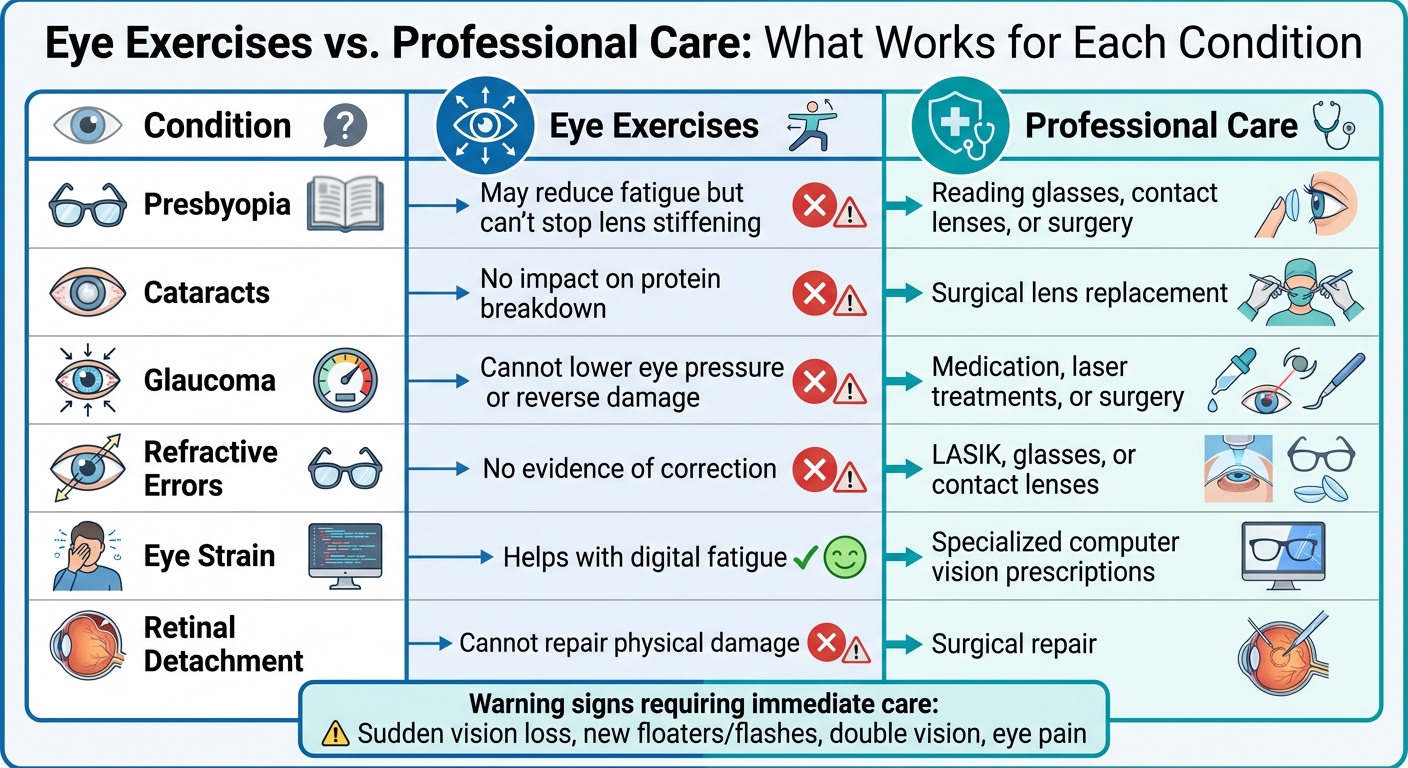
Eye Exercises vs Professional Care for Age-Related Vision Problems
Eye exercises can be helpful for relieving strain and improving focus temporarily, but they fall short when it comes to addressing more serious or structural vision problems. Conditions like presbyopia, cataracts, and glaucoma require medical intervention, as eye exercises cannot reverse the effects of aging or disease. As Benjamin Botsford points out, no study has demonstrated that exercises can eliminate the need for corrective lenses.
Eye Exercises vs. Professional Care: A Comparison
It’s important to know the limits of eye exercises and recognize when professional care is necessary. Here’s a breakdown of how the two approaches compare:
| Condition | Eye Exercises | Professional Care |
|---|---|---|
| Presbyopia | May reduce fatigue but can’t stop lens stiffening | Reading glasses, contact lenses, or surgery |
| Cataracts | No impact on protein breakdown | Surgical lens replacement |
| Glaucoma | Cannot lower eye pressure or reverse damage | Medication, laser treatments, or surgery |
| Refractive Errors | No evidence of correction | LASIK, glasses, or contact lenses |
| Eye Strain | Helps with digital fatigue | Specialized computer vision prescriptions |
| Retinal Detachment | Cannot repair physical damage | Surgical repair |
This table highlights when professional care becomes essential. Sudden vision loss, new floaters or flashes, double vision, or eye pain are signs of potentially serious issues that require immediate medical attention – eye exercises cannot address these emergencies.
How Denver Eye Surgeons Provides Complete Vision Care

For those dealing with vision problems that exercises can’t solve, Denver Eye Surgeons offers a wide range of solutions tailored to age-related and other complex eye conditions. Their services include cataract treatment with surgical lens replacement, advanced glaucoma management through medication or surgery, and specialized diabetic eye care to address retinal damage. For patients seeking permanent correction of refractive errors, they provide LASIK surgery, while their retina care services cover conditions like age-related macular degeneration.
The American Academy of Ophthalmology advises scheduling a comprehensive eye exam every year after age 50. Denver Eye Surgeons simplifies this process with same-day appointments and a skilled team of ophthalmologists and optometrists. These exams, which include dilation to examine the retina, can detect not only eye-specific conditions like glaucoma but also broader health issues such as diabetes, high blood pressure, and even certain cancers.
Combining Eye Exercises with Other Vision Health Habits
When it comes to protecting your vision, eye exercises work best as part of a bigger picture. They’re a helpful addition to your routine but shouldn’t replace professional care. For example, exercises like near–far focus shifts can ease digital eye strain, but they’re just one piece of the puzzle. Pairing them with other healthy habits creates a stronger foundation for long-term eye health.
Why Regular Eye Exams Matter
Eye exams aren’t just about updating your glasses or contacts. They’re a critical tool for spotting serious issues, like glaucoma or macular degeneration, early on. Dr. Melanie Akau from the University of Colorado School of Medicine highlights this point: