
Think your vision is fine because you passed a quick eye test? Think again. Vision screenings and eye exams are not the same, and understanding the difference could save your sight.
- Vision Screenings: These are brief tests (like those at schools or the DMV) that check for basic vision issues like nearsightedness or farsightedness. They take just a few minutes and are often done by non-specialists. However, they miss serious eye diseases.
- Eye Exams: Conducted by optometrists or ophthalmologists, these are in-depth evaluations of your vision and eye health. They include tests for conditions like glaucoma, cataracts, and diabetic retinopathy, and can even detect broader health issues like diabetes or high blood pressure.
Key takeaway: Screenings are a quick check; eye exams are a full health assessment. If you want to protect your vision long-term, regular eye exams are essential.
Ask an Eye Doc: Is there a difference between a vision screening and an eye exam?
What Is a Vision Screening?
A vision screening is a quick test designed to spot potential vision problems. Think of it as a first step – a way to flag issues that might need further investigation. These screenings are brief, often lasting just a few minutes, and focus on basic visual acuity, which measures how clearly you can see objects from a specific distance.
The main purpose of a vision screening isn’t to pinpoint a specific diagnosis. As WebMD puts it:
"Vision screening is a basic test that can detect eye or vision issues, but it won’t diagnose an exact problem".
If you or your child doesn’t pass the screening, it’s a signal to schedule a comprehensive eye exam with an optometrist or ophthalmologist. Let’s take a closer look at what these screenings evaluate and how they work.
Purpose and Scope of Vision Screenings
Vision screenings primarily check for refractive errors such as nearsightedness, farsightedness, and astigmatism. For children, they can also help identify conditions like amblyopia (lazy eye) or strabismus (crossed eyes). In adults, screenings may reveal presbyopia, which is the age-related difficulty in seeing things up close.
The tools used are simple yet effective. Wall-mounted eye charts, like the familiar Snellen chart, are common. For younger children, automated photoscreeners might be used. Screenings may also include basic tests for color vision, pupil responsiveness, and how well your eyes track moving objects.
Who Performs Vision Screenings?
Vision screenings are often conducted by individuals with minimal training. They’re commonly performed in schools by nurses, during routine visits to a pediatrician or family doctor, at the DMV for driver’s license renewals, or at community health events.
The American Optometric Association highlights a key concern:
"Often, administrative personnel or volunteers who have little training conduct a vision screening. While well-intentioned, these individuals do not have the knowledge to competently assess screening results".
While these screenings are helpful, they’re just the starting point. A comprehensive evaluation by an eye care professional is essential for a full assessment.
Limitations of Vision Screenings
Convenient as they are, vision screenings come with notable limitations. They don’t evaluate the internal health of your eyes. For example, screenings don’t include dilation to examine critical structures like the retina, optic nerve, or blood vessels. This means serious eye conditions – such as glaucoma, cataracts, diabetic retinopathy, or macular degeneration – can go unnoticed. These conditions often develop silently but can lead to permanent vision loss if not treated in time.
WebMD cautions:
"An incomplete vision screening may give a false sense of security and delay the detection of serious eye diseases".
Passing a vision screening simply means you can see well enough to read an eye chart from 20 feet away. It doesn’t guarantee your eyes are healthy. For a complete picture of your eye health, a thorough exam by an eye care professional is essential.
What Is a Comprehensive Eye Exam?
A comprehensive eye exam is a detailed evaluation of your vision and overall eye health. Unlike a quick vision screening, this type of exam dives deep, examining not only how well you see but also the internal structures of your eyes. It typically lasts between 30 and 60 minutes.
These exams are essential for detecting eye diseases, monitoring changes in vision, and even identifying broader health problems like diabetes or high blood pressure. Many serious eye conditions, such as glaucoma and macular degeneration, develop without noticeable symptoms. Early detection during these exams can make a huge difference in treatment outcomes.
As the Centers for Disease Control and Prevention (CDC) explains:
"A comprehensive dilated eye exam by an eye doctor can find eye diseases in the early stages. This is when treatment to prevent vision loss is most effective."
Here’s what makes a comprehensive eye exam stand out.
Key Components of a Comprehensive Eye Exam
A comprehensive eye exam involves multiple tests that together provide a full picture of your eye health and vision. Some of the most important tests include:
- Visual acuity testing: Measures how clearly you see.
- Refraction testing: Determines the right prescription for glasses or contact lenses.
- Tonometry: Screens for glaucoma by measuring eye pressure.
- Slit lamp examination: Uses a high-magnification device to check the front of the eye.
- Ophthalmoscopy: Examines the retina and optic nerve after dilation.
- Visual field testing: Assesses your peripheral (side) vision.
Pupil dilation is a key part of most comprehensive exams. Special eye drops are used to widen your pupils, allowing the doctor to get a clear view of the retina and optic nerve. Since dilation can cause temporary blurriness and light sensitivity, it’s wise to bring sunglasses and arrange for someone to drive you home.
Who Performs Comprehensive Eye Exams?
These exams are conducted by licensed eye care professionals, either optometrists (OD) or ophthalmologists (MD or DO).
- Optometrists: After earning an undergraduate degree, optometrists complete four years of optometry school. They provide primary vision care, including eye exams, corrective lens prescriptions, and treatment for many eye conditions.
- Ophthalmologists: These are medical doctors who complete medical school and a residency. They offer a full range of care, including advanced medical treatments and surgeries for conditions like glaucoma, cataracts, and retinal diseases.
Conditions Detected in Comprehensive Eye Exams
Unlike basic vision screenings, comprehensive exams can uncover a wide range of eye conditions, including:
- Glaucoma: Damage to the optic nerve, often linked to high eye pressure.
- Cataracts: Clouding of the eye’s lens.
- Diabetic retinopathy: Damage to the retinal blood vessels caused by diabetes.
- Macular degeneration: Deterioration of the central part of the retina.
For children, these exams can identify conditions like amblyopia (lazy eye), which affects 2 to 3 out of every 100 children, and strabismus (crossed eyes).
These exams don’t just stop at eye health. By examining the blood vessels and internal structures of the eye, doctors can sometimes detect signs of broader health issues such as diabetes, high blood pressure, or neurological disorders.
Vision Screening vs. Comprehensive Eye Exam: Side-by-Side Comparison
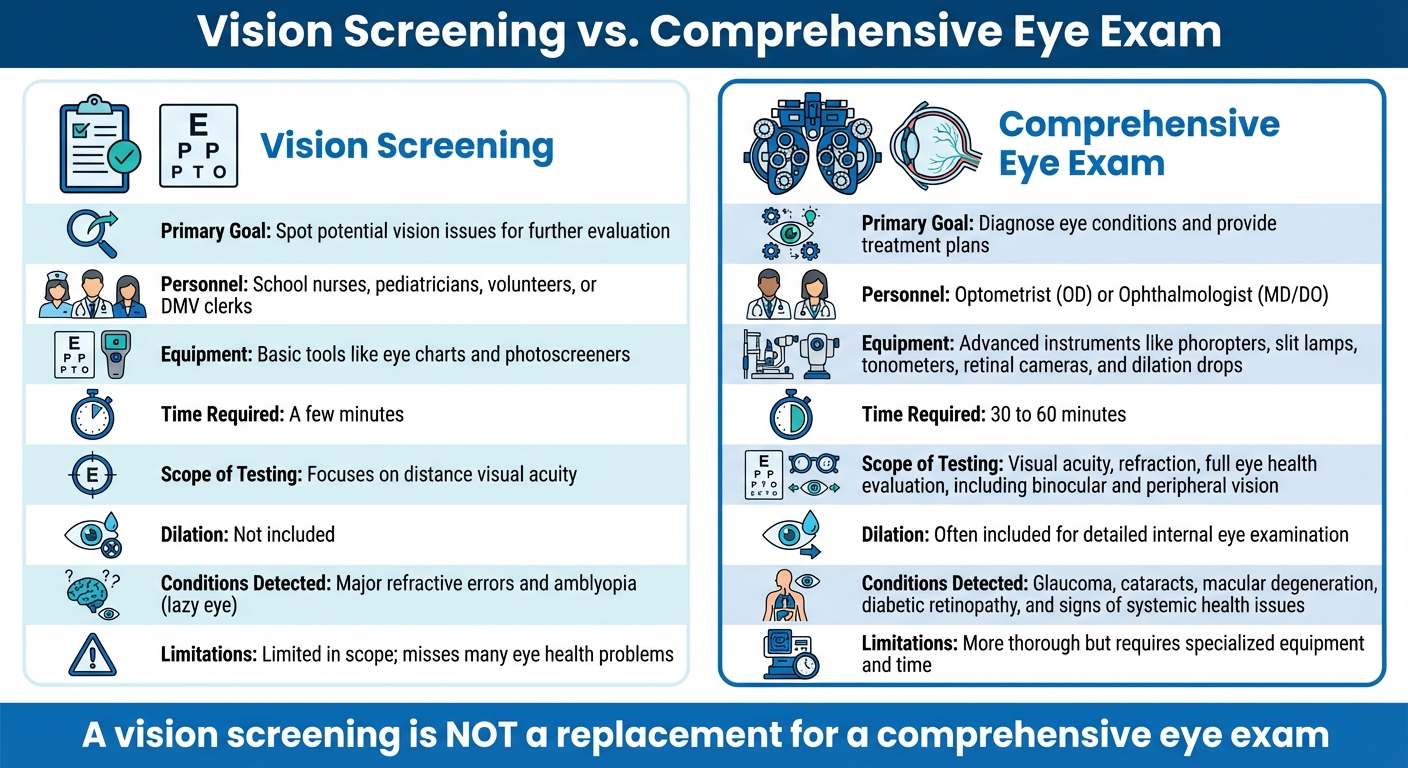
Vision Screening vs Comprehensive Eye Exam Comparison Chart
Here’s a clear breakdown of how vision screenings differ from comprehensive eye exams. Understanding these differences is key to making the right choice for your eye care needs.
It’s important to note: a vision screening is not a replacement for a comprehensive eye exam.
Comparison Table
| Feature | Vision Screening | Comprehensive Eye Exam |
|---|---|---|
| Primary Goal | Spot potential vision issues for further evaluation | Diagnose eye conditions and provide treatment plans |
| Personnel | Conducted by school nurses, pediatricians, volunteers, or DMV clerks | Performed by an Optometrist (OD) or Ophthalmologist (MD/DO) |
| Equipment | Basic tools like eye charts and photoscreeners | Advanced instruments like phoropters, slit lamps, tonometers, retinal cameras, and dilation drops |
| Time Required | Takes only a few minutes | Typically lasts 30 to 60 minutes |
| Scope of Testing | Focuses on distance visual acuity | Covers visual acuity, refraction, and a full eye health evaluation, including binocular and peripheral vision |
| Dilation | Not included | Often included for a detailed internal eye examination |
| Conditions Detected | Identifies major refractive errors and amblyopia ("lazy eye") | Detects glaucoma, cataracts, macular degeneration, diabetic retinopathy, and signs of systemic health issues |
| Limitations | Limited in scope; misses many eye health problems | More thorough but requires specialized equipment and time |
In short, while vision screenings can catch some basic issues, they don’t provide a full picture of your eye health. For a complete evaluation, it’s best to schedule a comprehensive eye exam with a licensed eye care professional. The next sections explain when to opt for each type of assessment.
sbb-itb-929a4e2
When to Choose a Vision Screening
Vision screenings are a quick way to identify potential vision problems that may need further attention. They’re especially useful in settings like schools, pediatric visits, and community health programs.
Schools and pediatric visits are among the most common places for vision screenings. School nurses often conduct these tests to spot students whose vision issues might be affecting their learning. With about 1 in 4 school-aged children having an undiagnosed or untreated vision problem, these screenings play a crucial role in ensuring kids who struggle to see clearly get the care they need. Experts recommend regular screenings at ages 3, 4, 5, 8, 10, 12, and 15, even if no symptoms are noticeable. For younger children, especially those too young for traditional eye charts, pediatricians use specialized devices to capture detailed eye images during routine checkups. This is important since roughly 1 in 17 young children has an undetected vision disorder that could impact their development.
DMV visual acuity tests are another example, ensuring drivers meet the minimum vision requirements for safe driving. Similarly, community health programs like Head Start provide screenings to families who may not have consistent access to eye care. Statistics indicate that up to 1 in 5 children in Head Start programs has a vision issue. Some workplaces also offer vision screenings to identify problems that could affect job performance or safety. These varied settings highlight how screenings serve as an accessible entry point into vision care.
It’s important to remember that screenings are just a preliminary check. If a screening flags a potential issue – or if you’re experiencing symptoms like squinting, headaches, or blurry vision – it’s crucial to schedule a comprehensive eye exam right away. Acting quickly on screening results can make all the difference in protecting your vision.
When to Choose a Comprehensive Eye Exam
Vision screenings are helpful for spotting obvious issues, but a comprehensive eye exam is essential for a full diagnosis – especially if you have risk factors. Here’s a general guideline: adults aged 18–64 should have a comprehensive exam every two years, while those 65 and older should go annually. For children, the schedule starts with an initial exam at 6–12 months, followed by another between ages 3–5, and then yearly exams after that . These regular checkups are crucial because symptoms can develop quickly and require immediate attention.
But routine exams aren’t the only time to visit your eye doctor. If you experience symptoms like decreased vision, eye pain, redness, discharge, double vision, floaters, flashes of light, or halos, don’t wait – schedule an exam right away. For kids, warning signs like squinting, tilting their head, closing one eye, blinking excessively, struggling to read, or becoming irritable during close-up tasks should prompt a visit to the eye doctor.
If you have diabetes, a yearly dilated eye exam is a must to help prevent or slow blindness caused by diabetic retinopathy. Similarly, individuals with a family history of glaucoma, high blood pressure, or other eye diseases should make annual exams a priority. As Howard Krauss, MD, a Surgical Neuro-ophthalmologist at Pacific Neuroscience Institute, emphasizes:
"There is no hard and fast rule in terms of how frequently people should have eye exams, however, symptoms and risk factors should never be ignored".
Some of the most serious eye conditions, like glaucoma or early-stage diabetic retinopathy, don’t come with obvious symptoms. They can quietly damage your vision, and only a dilated eye exam can catch them early . In fact, comprehensive eye exams can reveal more than 270 serious systemic health issues, including diabetes, high blood pressure, autoimmune conditions, and even certain cancers.
Shockingly, only about half of people at high risk for vision loss visit an eye doctor every year. If you wear contact lenses, take medications that could affect your eyes, work in a visually demanding job, or haven’t had an exam in over two years, it’s time to book your appointment. Don’t wait – your eyes deserve the care.
Benefits of Comprehensive Eye Exams at Denver Eye Surgeons
Denver Eye Surgeons stands out for its dedication to delivering top-tier care through advanced diagnostic tools, a wide range of services, and a patient-first approach.
Advanced Diagnostic Tools and Expertise
Using cutting-edge technology like OCT, slit lamps, and tonometry, Denver Eye Surgeons provides thorough eye evaluations. With over 35 years of service to the Denver community, the practice boasts an impressive legacy. Founder Dr. William Hines has performed more than 50,000 LASIK procedures and 10,000 cataract surgeries. This combination of extensive experience and state-of-the-art equipment ensures patients receive precise diagnoses and tailored treatment plans.
Comprehensive Range of Services
Beyond routine eye exams, Denver Eye Surgeons offers a wide array of specialized treatments. These include Custom Wavefront LASIK for precise vision correction, LipiFlow for dry eye relief, cataract surgery with advanced intraocular lenses, Visian ICL for vision improvement, and treatments for corneal and retinal conditions. If an exam uncovers conditions like glaucoma, diabetic retinopathy, or macular degeneration, patients can access treatment on-site from the same trusted team. This seamless approach to care ensures convenience and continuity for every patient.
Focused on Patient Care
Denver Eye Surgeons pairs its advanced diagnostics and comprehensive services with a strong emphasis on patient-focused care. They offer same-day appointments for urgent concerns and consistently earn glowing 5-star reviews. The Hines Sight Team captures their mission perfectly:
"Our mission is to maximize the vision and health of each of our patients. We strive to compassionately provide efficient care, without sacrificing quality".
To streamline visits, the practice also provides online patient forms, ensuring appointments are both efficient and thorough, respecting your time while addressing your eye care needs.
Conclusion: Choosing the Right Option for Your Vision Health
Understanding the distinction between vision screenings and comprehensive eye exams is key to safeguarding your eyesight. Vision screenings are quick assessments that can identify potential problems but often lack the depth to catch serious conditions. On the other hand, comprehensive eye exams provide a detailed evaluation, helping diagnose specific diseases and create tailored treatment plans.
Serious eye conditions like glaucoma, diabetic retinopathy, and macular degeneration often develop silently, showing no obvious symptoms. A full exam – including dilation and advanced diagnostic tools – is the only way to detect these issues early, when treatment is most effective.
Routine exams are crucial for maintaining eye health. For adults aged 18–64, an exam every two years is recommended, while those 65 and older should have annual exams. For individuals with diabetes, early detection and treatment can prevent or delay blindness in 90% of cases caused by diabetic retinopathy.
At Denver Eye Surgeons, advanced diagnostic tools and efficient services are at the heart of their comprehensive care. From routine vision correction to specialized treatments for complex conditions, they offer same-day appointments and access to a wide range of services – all conveniently available in one location.
Proactive eye care is essential for preserving your vision. Take the first step today by scheduling a comprehensive eye exam with Denver Eye Surgeons. Your vision deserves this level of care and attention.
FAQs
Why isn’t a vision screening enough to detect serious eye problems?
Vision screenings are a quick way to check basic eyesight – like how clearly you see things at a distance or if you might need glasses. They’re helpful for spotting obvious vision problems but don’t go beyond the surface. These screenings won’t catch early warning signs of more serious issues like glaucoma, cataracts, or retinal diseases.
That’s where comprehensive eye exams come in. These involve a thorough check-up by an eye care professional, using advanced tools to look for problems that may not yet show any symptoms. Regular exams are key to protecting your eye health and addressing potential issues before they have a chance to impact your vision.
How often should I get a comprehensive eye exam to maintain healthy vision?
For adults without particular risk factors, it’s generally suggested to have a detailed eye exam every two years. However, if you’re 65 or older, or if you have conditions like diabetes, a family history of glaucoma, or need corrective lenses, scheduling an annual exam is a better approach. These routine check-ups play a crucial role in spotting vision changes early and ensuring your eyes stay healthy.
What conditions can a comprehensive eye exam detect that a vision screening might overlook?
A thorough eye exam goes far beyond the basics of a standard vision screening. While vision screenings are designed to catch refractive issues like nearsightedness or farsightedness, a comprehensive eye exam dives deeper, assessing the overall health of your eyes. This type of exam can detect serious conditions such as glaucoma, cataracts, macular degeneration, and diabetic retinopathy – issues that might otherwise go unnoticed.
What’s more, these exams can also uncover early warning signs of broader health problems, like diabetes or high blood pressure, which aren’t typically identified during routine vision screenings. Scheduling regular eye exams is a key step in protecting not just your eyesight but your overall well-being.