
Did you know cataracts are the leading cause of blindness in the U.S. and worldwide? Regular eye exams can detect cataracts early, even before symptoms like blurry vision or light sensitivity become noticeable. Early detection allows for timely treatment, preserving your vision and quality of life.
Here’s how eye exams help identify cataracts early:
- Visual Acuity Test: Measures how clearly you see and spots early signs like blurred or hazy vision.
- Slit-Lamp Exam: Offers a magnified view of your eye’s lens to detect cloudiness caused by cataracts.
- Dilated Retinal Exam: Uses eye drops to widen the pupil, allowing a closer look at the lens and retina for early cataract signs.
- Advanced Imaging (OCT): Provides detailed 3D images of the eye, helping doctors assess cataracts and plan surgery if needed.
If you’re over 40, scheduling regular eye exams is crucial to catch cataracts early and prevent vision loss. Clinics like Denver Eye Surgeons use advanced tools and personalized care to ensure early diagnosis and effective treatment. Don’t wait – book an eye exam today to protect your vision.
What to Expect: Eye Tests for Cataract and General Assessment
Standard Eye Exam Tests for Cataract Detection
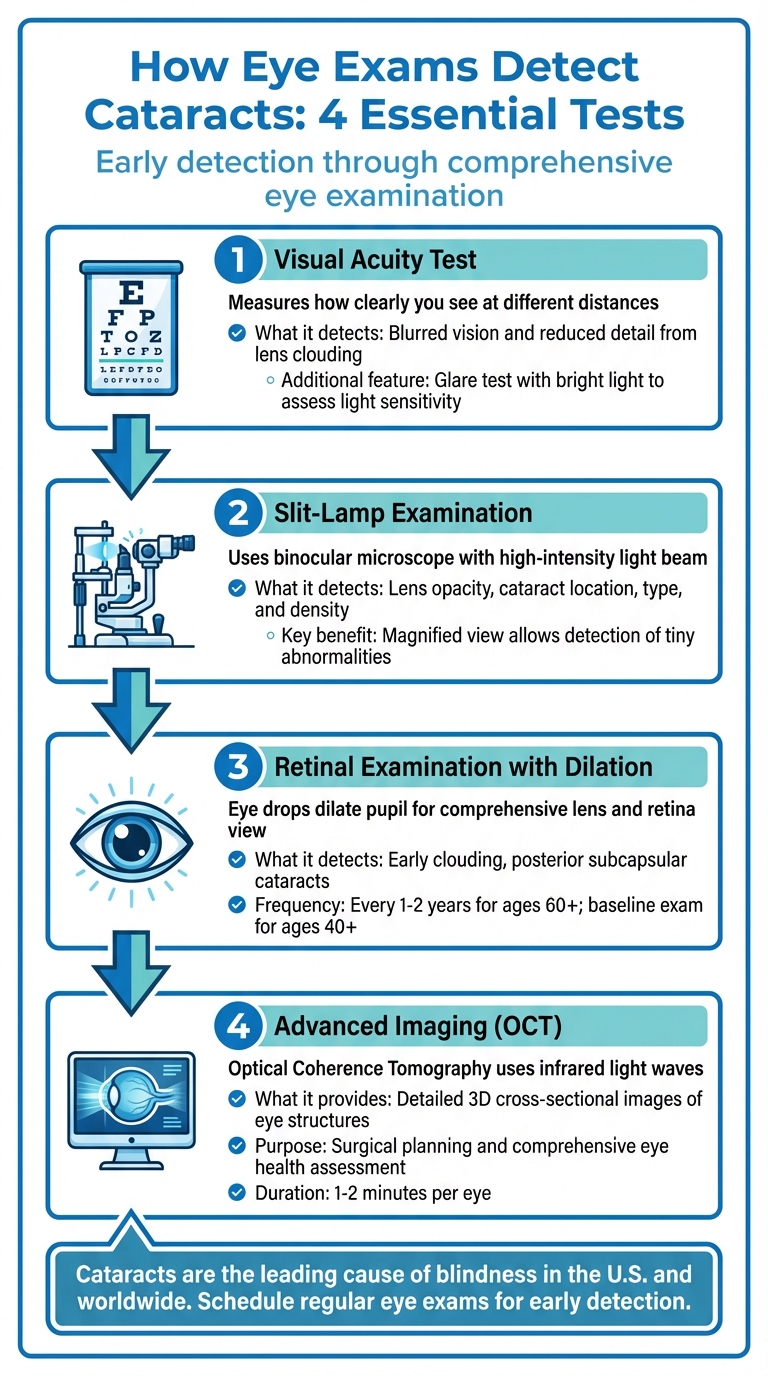
4 Key Eye Exam Tests That Detect Cataracts Early
Routine eye exams include a series of tests designed to catch early signs of cataracts.
Visual Acuity Test
One of the first tests performed during an eye exam is the visual acuity test, which measures how clearly you can see at different distances using a standard eye chart. Each eye is evaluated separately to determine the smallest letters you can read accurately. Early cataract symptoms, such as blurred vision and reduced detail, can often be detected during this test as the lens begins to cloud. To further assess light sensitivity, a glare test might be conducted by shining a bright light into the eye while you read the chart – light sensitivity is a common symptom of cataracts. After this initial test, a more detailed examination using a slit lamp provides a closer look at the eye’s internal structures.
Slit-Lamp Examination
The slit-lamp exam uses a specialized binocular microscope paired with a high-intensity light beam focused into a thin slit, offering a magnified and detailed view of the eye’s interior. During this test, you rest against a support while the ophthalmologist inspects your eye in sections. As described by Mayo Clinic:
The microscope allows your doctor to view these structures in small sections, which makes it easier to detect any tiny abnormalities.
This examination is especially useful for identifying lens opacity, the clouding caused by proteins clumping together to form cataracts. The slit-lamp test also helps determine the cataract’s location, type, and density within the lens layers. Following this, a dilated retinal exam offers a deeper look into the eye.
Retinal Examination with Dilation
To perform a retinal exam, eye drops are used to dilate the pupil, allowing the ophthalmologist to examine a larger portion of the lens and detect early clouding or opacity. This step provides a clear view of the retina and optic nerve at the back of the eye. It’s particularly helpful in identifying specific cataract types, such as posterior subcapsular cataracts, which develop at the back of the lens. Additionally, examining the retina can help predict the success of potential cataract surgery. If other retinal conditions are present, achieving 20/20 vision post-surgery may not be possible. For this reason, experts recommend that individuals aged 60 or older have a dilated eye exam every one to two years. Adults aged 40 and up should also undergo comprehensive exams with dilation to establish a baseline.
Advanced Diagnostic Tools for Cataract Detection
Standard eye exams are essential for identifying cataracts, but advanced imaging technologies take the evaluation a step further. These tools provide a more detailed look, helping to refine diagnoses and treatment plans.
Ophthalmoscopy and Retinal Imaging
Ophthalmoscopy is a key test for examining the retina, optic nerve, and blood vessels. When cataracts are present, they appear as cloudy areas during the exam. Beyond identifying cataracts, this test can also uncover other serious eye conditions like macular degeneration, glaucoma, and diabetic retinopathy.
Digital retinal imaging, such as Optos, offers a wide-angle view of the retina without requiring pupil dilation. This technology creates a digital record, making it easier to monitor subtle changes in the retina and optic nerve over time. As Eyeland emphasizes:
Many eye diseases can be treated successfully without total loss of vision.
For adults aged 65 and older, annual comprehensive eye exams are highly recommended to detect cataracts and other age-related vision issues. If you have diabetes, it’s crucial to schedule a dilated eye exam at least once a year.
Optical Coherence Tomography (OCT)
Optical Coherence Tomography (OCT) is a cutting-edge, noninvasive imaging technique that uses infrared light waves to generate detailed cross-sectional and 3D images of your eye’s internal structures. As Cleveland Clinic explains:
Optical coherence tomography (OCT) is a noninvasive imaging method that eye care specialists use to produce cross-sectional images of your eye. It works by measuring wavelengths of infrared light that reflect off the back of your eye.
While standard exams can detect cataracts, OCT provides an in-depth look at lens clarity and the front of the eye, which is invaluable when planning cataract surgery. This imaging method enables ophthalmologists to examine the eye layer by layer and measure the depth of key structures, ensuring a comprehensive understanding of eye health before surgery. OCT is also effective in identifying other conditions, such as macular degeneration, glaucoma, or diabetic retinopathy, which could influence the success of cataract surgery.
Each OCT scan takes just 1–2 minutes per eye. If dilation is part of the process, your vision may remain blurred for several hours, so arranging alternative transportation is a good idea.
sbb-itb-929a4e2
Early Cataract Detection at Denver Eye Surgeons
Comprehensive Eye Exams at Denver Eye Surgeons
For over 40 years, Denver Eye Surgeons has been a trusted name in Denver eye care, offering cutting-edge diagnostics to catch cataracts in their earliest stages. Their approach blends state-of-the-art technology with a commitment to patient-centered care.
When you visit Denver Eye Surgeons, your personalized exam starts with a review of your medical history and specific tests to evaluate the clarity of your lenses. These comprehensive eye exams typically take between one and two hours. During the exam, ophthalmologists use dilated eye exams to widen the pupil, allowing a clear view of the lens and retina. This helps them spot protein clumping or clouding – key indicators of cataract development. Advanced imaging tools are also used to capture detailed photographs of vital eye structures, such as the macula and cornea, to monitor your eye health and detect any early changes. Additionally, they employ OCT (optical coherence tomography) to closely examine the retina. This thorough evaluation is the foundation for crafting a treatment plan tailored to your specific needs.
Skilled Ophthalmologists and Tailored Treatment Plans
One of the standout features of Denver Eye Surgeons is their continuity of care model, where the same surgeon who evaluates your eyes also performs your surgery. This ensures your doctor fully understands your unique eye health throughout the entire process. As the practice proudly states:
We like to provide our patients with the same technology that we would offer to our own family member.
Their surgeons take the time to have in-depth preoperative discussions, helping patients choose between standard monofocal IOLs (covered by insurance) and premium elective IOLs. These recommendations are based on each patient’s specific vision needs and lifestyle, demonstrating a proactive approach to cataract care. By maintaining continuity from diagnosis to surgery, Denver Eye Surgeons ensures a seamless and personalized experience.
Patients often express their gratitude for the attentive and compassionate care they receive. Lori Holden, a patient, shared her experience:
Dr. Kumar’s staff held my hand the whole way. I was petrified. But I researched to find the very skilled Dr. Kumar and the very kind assistants who dealt effectively with my fear.
Conclusion
Getting routine eye exams is essential for protecting your vision and catching cataracts early. Cataracts are the leading cause of blindness in both the United States and around the world. By identifying them early through comprehensive eye exams, you can improve surgical outcomes and safeguard your vision before the condition worsens.
If you’re over 40, it’s time to prioritize your eye health with comprehensive exams that include pupil dilation. These exams can detect lens clouding and protein buildup – key indicators of cataracts – before they start to affect your vision.
Denver Eye Surgeons exemplifies this proactive approach to eye care. Using advanced diagnostic tools and a patient-focused care model, they ensure a seamless experience. From diagnosis to surgery, the same expert surgeon will oversee your treatment, providing continuity and personalized attention. Their team is committed to helping you maintain clear vision through early detection and expert care.
Don’t wait – schedule your comprehensive eye exam with Denver Eye Surgeons today and take an important step toward preserving your vision for years to come.
FAQs
How often should I have an eye exam to catch cataracts early?
It’s a good idea to get a detailed eye exam every two years. However, once you hit 60 – or if you have conditions like diabetes or a family history of cataracts – annual check-ups are a smarter choice. These regular visits play a crucial role in catching cataracts early, which can make a big difference in treatment success and keeping your vision sharp.
How do eye exams help detect cataracts early?
Routine eye exams are essential for catching cataracts early, which makes timely treatment possible. During these exams, your eye doctor will conduct a series of tests to evaluate both your vision and overall eye health.
The visual acuity test checks how clearly you can see, identifying any loss of sharpness that might suggest cataracts. A slit-lamp exam allows the doctor to examine your eye’s lens and other structures under magnification, making it easier to spot early signs of clouding. With a dilated eye exam, special drops are used to widen your pupils, giving the doctor a closer look at your retina and optic nerve while also detecting subtle lens changes. Additionally, tonometry may be used to measure eye pressure, ensuring your eyes are in good health overall.
At Denver Eye Surgeons, these tests are part of every comprehensive eye exam, designed to detect cataracts early and offer tailored treatment options to safeguard your vision.
Can cataracts be treated effectively if caught early?
Yes, cataracts can be treated successfully, especially when caught early. Early detection ensures better planning and treatment, often leading to excellent results. Cataract surgery is a safe and effective procedure that can significantly restore vision, with the best outcomes achieved before the condition becomes advanced.
Routine eye exams play a key role in spotting cataracts in their early stages. Early diagnosis allows you to explore treatment options sooner, helping to prevent further vision loss. If you’re in Denver, Denver Eye Surgeons provides comprehensive eye care services, including cataract diagnosis and treatment, all with a focus on patient care and comfort.