
Cataract surgery is a quick outpatient procedure that replaces the eye’s cloudy lens with a clear artificial one, improving vision and quality of life. Over 90% of patients report better vision post-surgery, with many regaining independence in daily activities like driving and reading. This article shares real-life patient experiences, highlighting the transformative effects of restored vision, from seeing vibrant colors to resuming beloved hobbies. Whether you’re considering cataract surgery or curious about the process, these stories provide valuable insights into its life-changing potential.
Patient Story 1: From Fear to Clear Vision
Addressing Surgery Concerns
Bob Puzio from Morris Township faced a unique challenge when it came to cataract surgery. A childhood eye injury left him with uncontrollable spasms whenever someone approached his eyes. Reflecting on his anxiety, Bob shared:
"When people would get close to my eyes, I would spasm – I just couldn’t control it".
The idea of undergoing cataract surgery felt daunting and overwhelming.
Dr. Eric Mann and his team at Denver Eye Surgeons approached Bob’s concerns with patience and understanding. They provided detailed explanations about the procedure and took the time to answer every question, ensuring he felt comfortable and informed. The team also reassured Bob that the anesthesia used during the 15- to 30-minute procedure would keep him relaxed, preventing him from seeing any surgical instruments near his eyes.
This thoughtful communication helped ease Bob’s fears, paving the way for a smooth and successful experience.
Life After Surgery
In January and February 2024, Bob underwent two cataract surgeries, both of which were successful. To his surprise, he found the process far less intimidating than he had imagined, describing it as:
"easier than going to the dentist".
Before the surgery, Bob’s vision was clouded by a "yellow straw" tint. Afterward, the difference was striking – he described the world as being "bright as an LED light". This dramatic change underscored just how transformative clearer vision can be.
With his improved eyesight, Bob could see sharp details and vibrant colors like never before. This newfound clarity allowed him to return to his passions, such as traveling and collecting craft brewing memorabilia, with renewed enthusiasm. Reflecting on his journey, Bob said:
"When Dr. Mann told me that I needed surgery as soon as possible, I thought, ‘Why?’ But now, everything I see is sharper, brighter and clearer".
sbb-itb-929a4e2
Patient Story 2: Seeing Colors and Details Again
Before Surgery: Faded Colors and Blurred Vision
Jane, an avid gardener, started noticing some unsettling changes in her vision back in 2022. Her once-brilliant orange dahlias seemed dull, almost yellow. The intricate details of her garden blurred together, making it hard to distinguish individual flowers or even spot weeds from a distance.
It wasn’t just her gardening that suffered. Everyday activities became more difficult. Tasks like grooming felt frustrating, and driving at night turned into a nerve-wracking experience due to the harsh glare of oncoming headlights. Like many living with cataracts, Jane unknowingly adjusted to a clouded view of the world, not fully realizing how much she had lost. Her struggles set the stage for a remarkable turnaround after surgery.
After Surgery: Bright Colors and Clear Vision
After her cataract surgery at Denver Eye Surgeons in 2022, Jane experienced a life-changing shift. With her vision restored to 20/20, she immediately noticed the world in a whole new light. Colors were vibrant again – her orange dahlias looked like themselves for the first time in years. She could even spot a single weed from 30 feet away, something she never thought possible before.
"Before, I couldn’t see my orange dahlias clearly – they all looked yellow. Now, I can spot a weed at 30 feet! It’s made a complete transformation to brighter, clearer vision." – Jane, Patient, Denver Eye Surgeons
This newfound clarity didn’t just enhance her vision – it gave her confidence and independence back. She could now drive at night without fear and fully enjoy the beauty of her garden. Feeling inspired by her renewed outlook, Jane began planning an exciting trip to Singapore and Japan, where she hopes to try scuba diving for the first time.
Patient Story 3: Getting Back to Hobbies
How Vision Problems Limited Activities
Dennis Fenton, a professional woodworker with 25 years of experience, faced a serious challenge when cataracts distorted his vision. Instead of seeing true wood tones, he saw three different hues. For someone whose craft relied on precise color differentiation, this posed a major threat to his career.
Jimmy Houston, a well-known fisherman, struggled with both near and far vision due to cataracts. This affected his ability to cast accurately and even impacted his shooting skills.
Eileen M., a passionate quilter, found herself unable to see the fine details required for intricate needlework, making her cherished hobby nearly impossible.
Returning to Favorite Activities
Despite these setbacks, each of these individuals found remarkable improvements after undergoing cataract treatment.
Dennis underwent "One-Drop" Cataract Surgery using Tecnis Multifocal Lenses at Denver Eye Surgeons in 2026. The results? He regained the color accuracy critical to his woodworking and even improved his shooting accuracy to 243 out of 250.
Jimmy opted for laser cataract surgery paired with a LifeStyle Lens, also at Denver Eye Surgeons in 2026. His precision in fishing returned to what it had been in his youth, and he could even read fine print on shampoo bottles again.
"My casting has come back to the way it was when I was a kid! They did a really remarkable job." – Jimmy Houston, Professional Fisherman
Eileen chose ReStor Multifocal IOLs in 2018, also at Denver Eye Surgeons. After the procedure, she was able to quilt, read fine print without glasses, and enjoy clear distance vision once more.
These stories showcase how cataract treatments can restore not just vision but also the activities and passions that enrich people’s lives. Up next, we’ll explore what to expect during the procedure itself.
“My Vision Is Clear Again”: A Cataract Surgery Patient Shares Her Story – Dr. Audrey Tai
What to Expect During Cataract Surgery
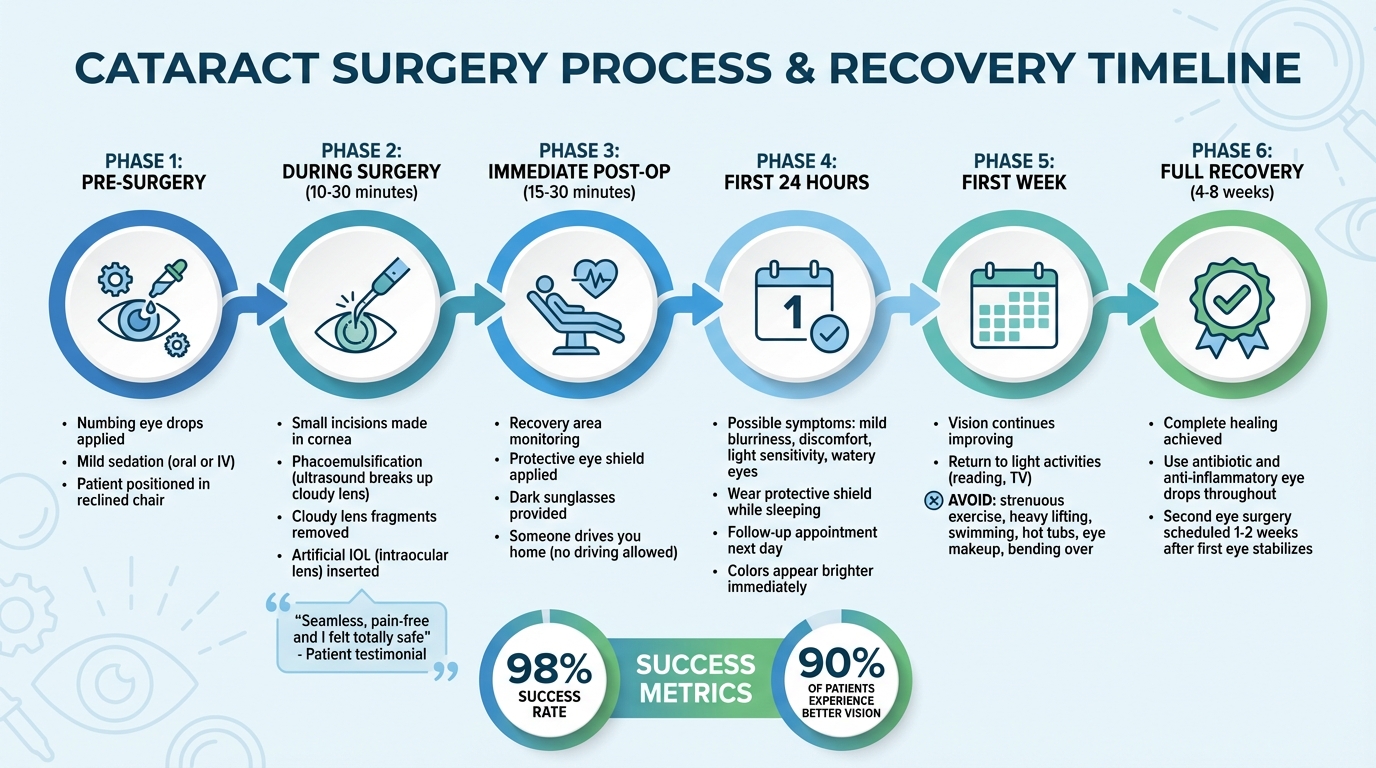
Cataract Surgery Timeline: What to Expect from Procedure to Recovery
The Surgery Process
Cataract surgery is a quick and straightforward procedure, typically lasting between 10 to 30 minutes. Before the surgery starts, you’ll receive numbing eye drops, and many patients are also given mild sedation – either orally or through an IV – to help them stay calm.
Once you’re prepped, you’ll be positioned in a reclined chair with head support. An instrument gently holds your eye open, and your vital signs are monitored throughout the procedure. The surgeon begins by making small, self-sealing incisions in your cornea. Using ultrasound energy, the cloudy lens is broken into tiny fragments through a process called phacoemulsification. These fragments are then removed, and an artificial intraocular lens (IOL) is placed into the lens capsule to restore clear vision.
Patients often describe the experience as smooth and painless. As one patient, Stacey Strongin, shared:
"The whole procedure usually took around 30 minutes and was seamless, pain-free and I felt totally safe throughout." – Stacey Strongin, Patient
After the surgery, you’ll spend about 15 to 30 minutes in a recovery area before heading home. You’ll leave with a protective eye shield and dark sunglasses, but since driving is not allowed, you’ll need someone to take you home. Post-surgery recovery protocols begin immediately to ensure proper healing.
Recovery Timeline
The recovery phase is designed to support a gradual return to clear vision. Within the first 24 hours, you might notice some blurriness, mild discomfort, light sensitivity, or watery eyes. You’ll wear a protective shield while sleeping and have a follow-up appointment the next day to check on your progress. Many people report that colors look brighter almost right away, even if the overall clarity of vision isn’t perfect yet.
Throughout the first week, your vision should continue to improve. By the end of the week, most patients can return to light activities like reading or watching television. However, it’s important to avoid strenuous exercise, heavy lifting, swimming, hot tubs, and wearing eye makeup during this time. Activities like bending over, which could increase pressure in the eye, should also be avoided.
While full healing usually takes four to eight weeks, many notice significant improvements within just a few days. To aid recovery, you’ll need to stick to a schedule of antibiotic and anti-inflammatory eye drops to prevent infection and reduce inflammation. If both eyes require surgery, the second procedure is generally scheduled one to two weeks after the first eye has stabilized. Cataract surgery boasts a 98% success rate, with around 90% of patients experiencing better vision afterward.
Vision Improvements: Before and After Results
Sharper Vision
Cataract surgery can bring a world of clarity that many patients haven’t experienced in years. For example, a 78-year-old patient once described trees as nothing more than a "big green blur", but after surgery, they could see every leaf in vivid detail. This newfound sharpness makes everyday tasks – like reading distant street signs, distinguishing between similar words, or recognizing faces from across the room – much easier.
Some results are truly astonishing. Take Vietnam War veteran Phil Cusimano, who had struggled with extreme nearsightedness for decades. Just two hours after his surgery in 2020, he could read the 20/10 line on an eye chart and achieved perfect 20/20 distance vision without corrective lenses. Similarly, in June 2024, Lissette Gonzalez, who had only light perception in her right eye before surgery, regained perfect 20/20 vision the day after undergoing femtosecond laser-assisted cataract surgery with Dr. Hardik Parikh at River Drive Surgery and Laser Center.
Beyond sharper vision, patients often notice a dramatic improvement in how they perceive colors.
Better Color and Contrast
Cataracts can dull colors over time, adding a yellowish tint that creeps in so gradually most people don’t even notice. Patients often describe the post-surgery experience as lifting a "yellow veil".
The difference can be eye-opening. One patient shared that after surgery, she realized her floral sofa, which she had thought was cream-colored, was actually a bright white and red pattern. She also discovered her "maroon" shoes were, in fact, a vibrant red. "Everything white looked like it had been bleached with Clorox!" she exclaimed. The improvement in contrast and vibrancy brings a fresh perspective to the world around them.
These changes often come with the added benefit of reduced dependence on corrective eyewear.
Less Need for Glasses
Thanks to advancements in intraocular lenses, many patients find they no longer need glasses after cataract surgery. Dr. Karen Christopher, an Assistant Professor of Ophthalmology, explains:
"We can essentially replace their prescription in their glasses with the prescription in the lens that gets implanted in their eye. That gives them a lot more independence from glasses going forward".
For long-time glasses or contact lens wearers, this newfound freedom can be transformative. In May 2025, 78-year-old Josephine Powell, who had relied on a -10.5 prescription and hard contact lenses for over five decades, faced a point where her cataracts made it impossible to get a safe prescription for driving. After opting for Extended Depth of Focus (EDOF) lenses in both eyes, she no longer needed glasses or contacts. Reflecting on her experience, she said:
"To now be free of all of that [contact lenses and emergency glasses] really is liberating!".
Long-Term Benefits of Cataract Surgery
Better Mental Health
Regaining clear vision does more than just improve eyesight – it can restore a sense of confidence and independence. Tasks that once felt frustrating or out of reach become manageable again, reducing feelings of isolation. Many patients experience an emotional lift, as better vision often leads to a more positive outlook on life. With sharper depth perception and improved night vision, everyday fears, like falling or driving in the dark, are diminished. This emotional boost not only enhances personal well-being but also strengthens social and professional interactions.
Improved Social and Work Life
Clearer vision paves the way for a more active and fulfilling lifestyle. Whether it’s reconnecting with loved ones, engaging in community activities, or excelling at work, improved eyesight makes everything feel more accessible. Tasks that demand focus – whether professional or personal – become less mentally taxing, allowing for greater enjoyment and productivity. This renewed visual clarity builds confidence in social settings, supports cognitive sharpness, and enhances overall quality of life.
Denver Eye Surgeons: Patient-Centered Cataract Care
Complete Cataract Treatment
Denver Eye Surgeons offers a blend of cutting-edge technology and a compassionate, patient-focused approach to cataract care. Their use of the LENSAR Laser System ensures precision in laser-assisted cataract procedures, often reducing the need for glasses post-surgery. Patients can select from a variety of lens options, including the Symfony multi-focal lens for enhanced near, far, and intermediate vision, or Light Adjustable Lenses (LAL) for tailored visual outcomes.
The team stands out for their ability to ease patient anxiety. Surgeons provide clear, step-by-step explanations during procedures, helping patients feel more at ease. They also accommodate urgent eye issues with same-day appointments, ensuring timely care. With a multi-specialty setup, the practice can manage additional conditions like glaucoma, dry eye, or retinal concerns, which might impact surgical outcomes – all within one facility. Their efficient processes also help keep wait times to a minimum, making the experience as smooth as possible.
Local Patient Success Stories
This combination of advanced techniques and personalized care has led to numerous success stories from local patients.
Dean Stoughton, who underwent cataract surgery in April 2025, initially felt nervous but was thrilled with the results. After working with Dr. Long and the surgical team, he achieved 20/20 vision and noticed a vibrant return of colors in his sight. Reflecting on his experience, he said:
"At first, having cataract surgery may be a bit anxious. After going through the whole process with Denver Eye Surgeons, it was amazingly easy and so well worth the effort."
Patti Dierking, another patient, underwent laser-assisted cataract surgery with Dr. Eugenia White in the same month. She praised the staff for being "friendly and knowledgeable." Lori Holden shared a similar story, overcoming her fear of the procedure thanks to the team’s supportive approach:
"Dr. Kumar’s staff held my hand the whole way. I was petrified. But I researched to find the very skilled Dr. Kumar and the very kind assistants who dealt effectively with my fear."
The practice’s commitment to excellence is reflected in its 4.5 out of 5-star rating based on 788 reviews as of March 2026. Patients frequently commend the professionalism of technicians like Chi Vu and surgeons such as Dr. Jonathan Noguchi and Dr. Sarah Crosby, who are known for their calm and reassuring demeanor.
Conclusion
Cataract surgery has the remarkable ability to restore vision, rekindle independence, and bring back the vibrant details of life. The patient experiences shared here highlight how a procedure lasting just 10 to 30 minutes can reverse years of visual decline. It enables people to drive safely again, return to beloved activities like woodworking or fishing, and clearly see the faces of their loved ones.
The results speak volumes: about 90% of patients report improved vision after cataract surgery, with many regaining clarity they hadn’t experienced in decades. As Deborah, one patient, put it:
"I am seeing better than I have ever seen in my entire life."
But it’s not just about physical vision. Cataract surgery also relieves the emotional weight of vision loss, helping patients regain confidence in navigating the world and reducing the anxiety or depression that often accompanies impaired sight. With a success rate of 95–98%, these outcomes are not just common – they’re expected.
These stories highlight the life-altering potential of modern cataract surgery. If you’re struggling with cloudy vision, difficulty driving at night, or challenges in seeing colors vividly, it might be time to consider your options. At Denver Eye Surgeons, advanced technology and personalized care come together to provide lens solutions tailored to your lifestyle. With same-day appointments and a proven history of success, there’s no reason to live with severe vision loss. Schedule a consultation and take the first step toward seeing the world – and your future – with clarity.
FAQs
How do I know it’s time for cataract surgery?
If your vision starts feeling blurry, cloudy, or takes on a yellowish tint, and it begins to interfere with everyday tasks like reading or driving, it might be time to consider cataract surgery. Some common warning signs include seeing halos around lights and struggling to see clearly at night. Regular eye exams are crucial – they help track the progression of cataracts and pinpoint the right moment for surgery.
Will I be awake, and will it hurt?
Yes, you’ll stay awake during cataract surgery. The procedure uses local anesthesia to numb the eye, ensuring you feel little to no pain. Most people find the process smooth and easy to handle.
What is the best lens option to reduce dependence on glasses?
To reduce reliance on glasses after cataract surgery, you might want to explore multifocal or extended depth of focus intraocular lenses (IOLs). These advanced lenses are crafted to enhance vision across near, far, and intermediate distances, offering a more comprehensive improvement in visual sharpness.